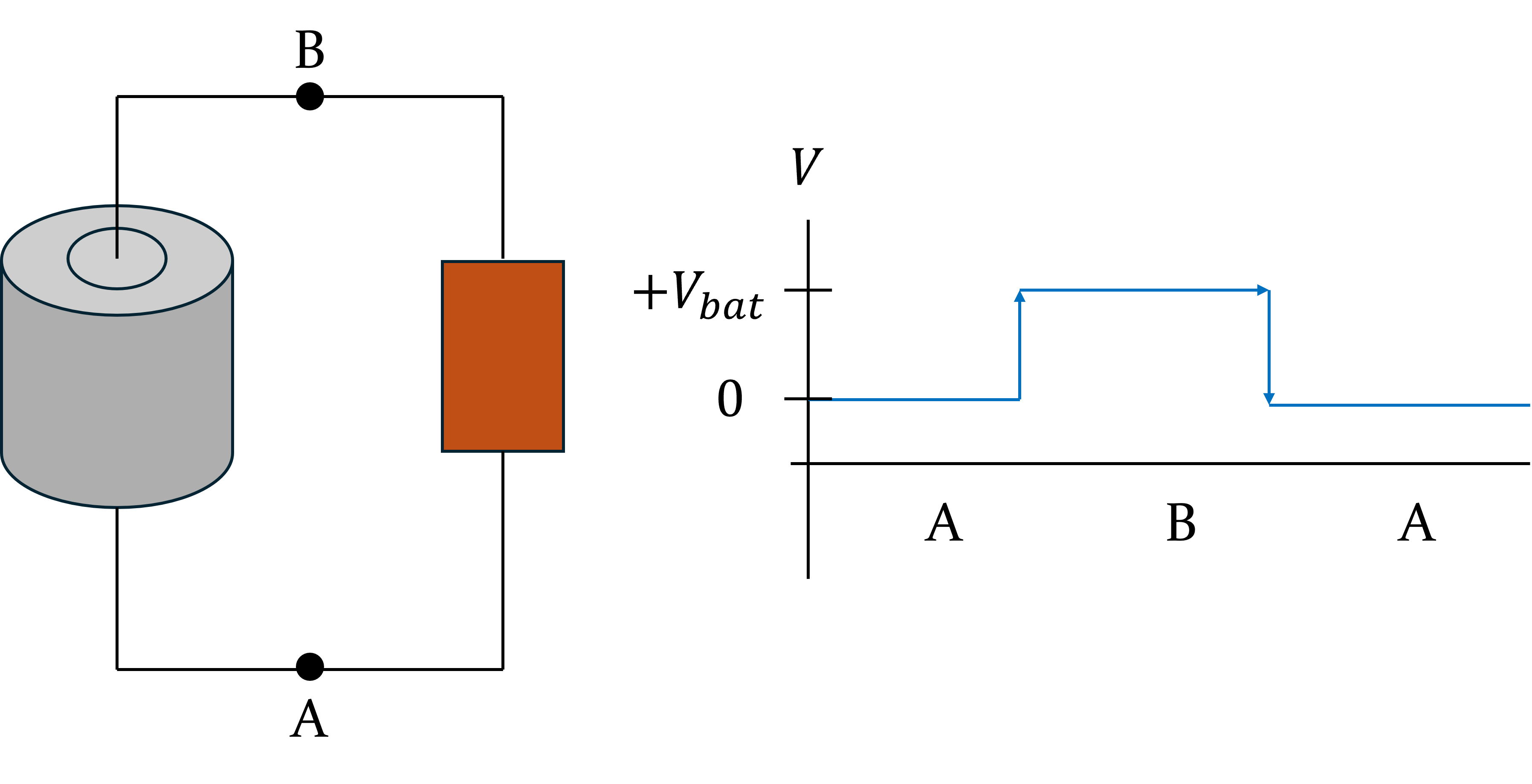
Pretend you are a little positive charge starting at the bottom left corner of the circuit from the end of the video. Sketch the voltage you experience as a function of time as you travel once around the circuit. Explain your reasoning behind your sketch.
A vertical arrow represents the voltage across a circuit element. The length of the arrow represents the size of the change, and the direction of the arrow represents whether the voltage increases or decreases.
The diagram starts at some reference point. A common reference is the bottom left corner, often at the negative terminal of a battery. You may typically choose this voltage to be zero.
The voltages around a complete loop sum to zero. The voltage diagram should end at the same reference point as it began, and the voltage at this final point should be the same as the initial voltage, according to The Loop Rule.
Figure26.4.3.A basic circuit and its associated voltage diagram. Two points, A and B, are defined between circuit elements. Voltage increases moving clockwise from point A to point B, then decreases by the same amount from B to A.