Learning Introductory Physics with Activities

Section 29.7 Challenge - Faraday’s Law

Explanation 29.7.1. The Moving Wire Loop.

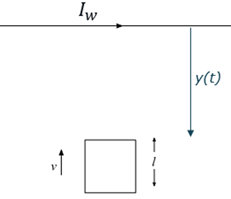
The square wire loop below is located below a long straight wire carrying current \(I_w\text{.}\) Each side of the circuit has length \(l\text{.}\)
Figure 29.7.1. A square wire loop moving upward toward a wire.
Make a magnetic induction table for each of the following cases:
  1. The loop is moving upward with constant speed \(v\text{.}\) Choose an area vector into the page.
  2. Repeat case A, but choose the area vector to be in the opposite direction.
  3. Repeat case A, but now the loop is moving downward with constant speed \(v\text{.}\)
  4. Repeat case A, but now the loop is moving to the left with constant speed \(v\text{.}\)
  5. Repeat case A, but now the loop is stationary and the long straight wire is moving upward with constant speed \(v\text{.}\)
Table 29.7.2. Blank Magnetic Induction Table
Quantity Case A Case B Case C Case D Case E
\(\vec{A}\)
\(\vec{B}\)
\(\Phi_B\)
\(\frac{d\Phi_B}{dt}\)
\(V_{ind}\)
\(I_{ind}\)
\(\vec{\mu}_{ind}\)

A*R*C*S 29.7.2. Charging your Phone.

You have a circular coil of radius 25 cm with 200 turns and resistance 5 \(\Omega\) that you would like to use to generate some power for charging your phone. You look up and see that 9 m above you is a long, straight power line that you estimate has a maximum current of 700 A alternating at 50 Hz. Estimate the maximum current through your coil.

Explanation 29.7.3. Square Loop.

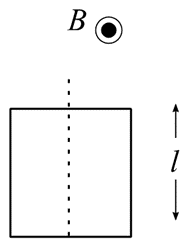
A square wire loop with resistance \(R\) is located in a region of uniform magnetic field \(B\text{.}\) Each side of the circuit has length \(l\) and the loop is rotating counterclockwise about a vertical axis (when viewed from above) with constant angular speed \(\omega\text{.}\) (The axis of rotation is shown as a dashed line.) The figure shows the loop at \(t = 0\text{.}\)
Figure 29.7.3. A square wire loop in a uniform magnetic field.
Explain how the magnetic flux and the induced current change over time. As part of your explanation, sketch two graphs, one of the magnetic flux vs. time and one of the induced current vs. time, and describe how flux and current are related using your graphs.