A circuit is made of conducting elements. Any object that is electrically conductive can be a circuit element. Common elements include wires, batteries, light bulbs, resistors, capacitors, and switches.
An electric field will force current to flow. For current to flow through the conductors that make up a circuit, an electric field must be present inside the conductors, when they are not in electrostatic equilibrium. Such an electric field is most commonly caused by including a battery in the circuit.
Current can flow through a complete circuit. A circuit is only complete if there is at least one continuous path of electrical conductors and circuit elements that starts and ends at the same location.
Current cannot flow through a broken circuit. If a circuit is broken by a nonconductive element, such as an insulator or an open switch, no current will flow. It only takes one break in a circuit to stop current from flowing.
Every circuit element has a voltage across it. The voltage is measured from one side of the element to the other and is usually represented as \(\Delta V_{\text{element}}\) or sometimes even just \(V_{\text{element}}\text{.}\)
Every circuit element has a current through it. The current is measured as the amount of positive charge passing through the element per unit time and is usually represented as \(I_{\text{element}}\text{.}\)
Imagine that you are a tiny positive charge, initially located at the dot in the Circuit Figure above. You begin moving clockwise through the circuit. As you pass through element A, you measure a gain in voltage of \(\Delta V_A = 5 \mathrm{~V}\) and you measure a current of \(I_A = 0.7 \mathrm{~A}\text{.}\) As you pass through element B, you measure a voltage decrease of \(\Delta V_B = -3 \mathrm{~V}\text{.}\)
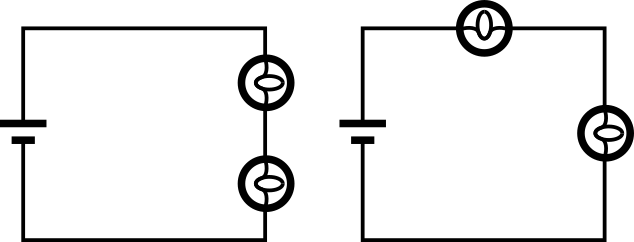
Circuit diagrams show electrical connections. The physical arrangement of the circuit elements does not matter: only how they are electrically connected.
Figure26.1.6.Example: two circuit diagrams. Although they look slightly different, the electrical connections are the same, so they represent the same physical circuit.