Section 23.2 Area Vectors
Subsubsection Key Ideas
Definition 23.2.2. Area Vector.
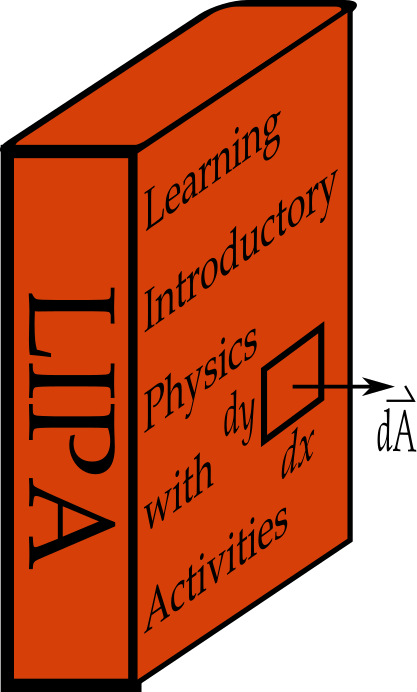
The area vector \(\vec{A}\) for a surface points perpendicular to the surface, as in the figure below, with a magnitude equal to the area of the surface. For an infinitesimal surface, the area vector is typically written \(d\vec{A}\text{.}\) An area vectors has units of \(\mathrm{m}^2\text{.}\)

Subsubsection Activities
Activity 23.2.1. Area Vectors for a Book.
Below is a picture of a closed surface (the outside cover of a book).

(a)
Which direction is the area vector for the front cover of the book? For the spine? How many different area vectors do you need for the entire book?
(b)
Sketch a differential area vector \(d\vec{A}\) for a small part of the front cover of the book and write it in terms of differential elements like \(dx\) and \(dy\text{.}\) Check that your expression has the correct units!
Solution.
The figure below shows an infinitesimal square section of the front cover of the book, where the area vector is \(\vec{dA} = dxdy\hat{z}\text{.}\) The units are correct here because both \(dx\) and \(dy\) have units of length, and \(\hat{z}\) is unitless.