Learning Introductory Physics with Activities

Section 26.5 Incandescent Light Bulbs

Subsubsection Activities

Activity 26.5.1. Warm-up.
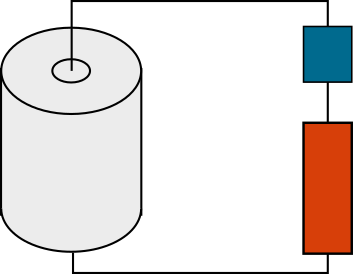
Consider the circuit shown below.
A stylized circuit diagram with a battery on the left and a small blue rectangle and a long orange rectangle on the right.
Figure 26.5.1. A stylized circuit diagram.

(a)

Is the circuit below complete?

(b)

Sketch a charge diagram and an electric field vector map.

(c)

Will current flow? Explain why or why not.

(d)

Draw a voltage diagram for the circuit.

(e)

Use the Loop Rule to write an equation relating \(V_bat\text{,}\) \(V_blue\text{,}\) and \(V_orange\text{.}\)

(f)

Use the Junction Rule to write an equation relating \(I_bat\text{,}\) \(I_blue\text{,}\) and \(I_orange\text{.}\)

(g)

How would things change if you opened a switch, as in the figure below?
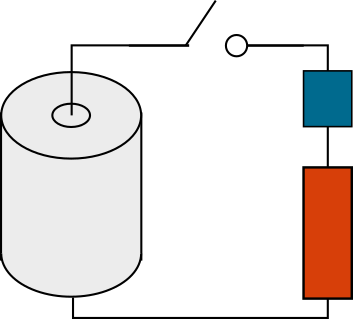
A stylized circuit diagram with a battery on the left and a small blue rectangle and a long orange rectangle on the right.  There is an open switch on the top branch.
Figure 26.5.2. A stylized circuit diagram with a switch.

Activity 26.5.2. Light Bulbs.

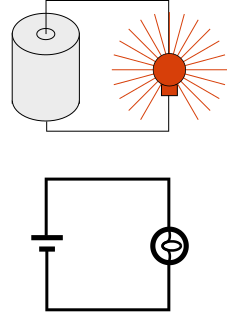
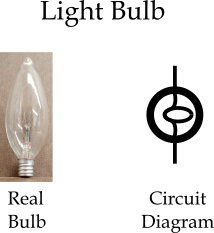
When you make the circuit shown below, you will see that the light bulb glows.
Above: a stylized circuit diagram with a battery on the left and a light bulb on the right.  Below, a corresponding circuit diagram.
Figure 26.5.4. A stylized and circuit diagram of a basic circuit.

(a)

Why do you think the light bulb glows? Give a mechanistic answer based on electric fields.
Solution.
Current is flowing through the bulb due to the electric field produced by the voltage provided by the battery. The charged particles collide with atoms, increasing the temperature of the metal in the light bulb. Hot things glow!

(b)

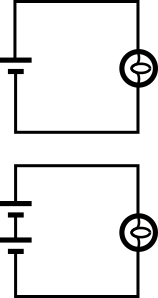
What do you think will happen to the light bulb if a battery is added to the circuit?
Above: a circuit diagram with one bulb and one battery.  Below: a circuit diagram with one bulb and two batteries.
Figure 26.5.5. Two circuit diagrams.

(c)

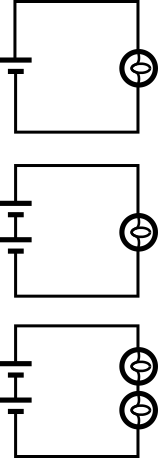
What if there are two batteries and two light bulbs?
Above: a circuit diagram with one bulb and one battery.  Middle: a circuit diagram with one bulb and two batteries.  Below: a circuit diagram with two bulbs and two batteries.
Figure 26.5.6. Three circuit diagrams.
Solution.
Your observations suggest a rule: for an incandescent light bulb, the voltage across the bulb is related to the brightness of the bulb.

(d)

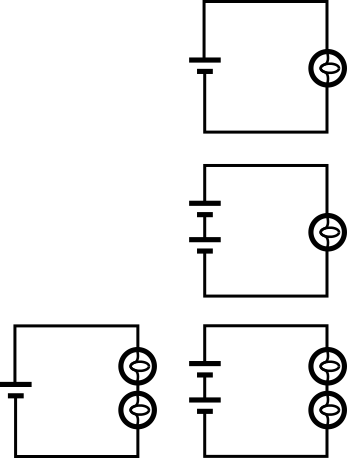
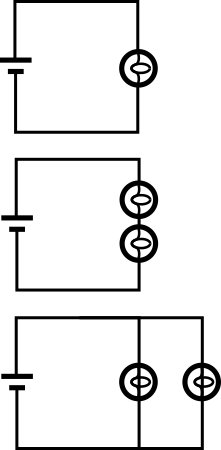
What if there are two bulbs but only one battery? Are there any bulbs that you know have the same current? How do you know?
Above: a circuit diagram with one bulb and one battery.  Middle: a circuit diagram with one bulb and two batteries.  Below: a circuit diagram with two bulbs and two batteries.  Below left: a circuit diagram with one battery and two bulbs.
Figure 26.5.7. Four circuit diagrams.
Solution.
Your observations suggest another rule: for an incandescent light bulb, the current through the bulb is related to the brightness of the bulb. This rule agrees with the power dissipated in a circuit element.
You can also stipulate the following: identical light bulbs with the same voltage also have the same current and therefore the same brightness.
Another important observation: the current through a battery is not fixed! It depends on what is in the circuit. This suggests thinking about the light bulbs as providing some obstacle to the flow of current in the circuit.

(e)

Which of the circuits you have considered do you think provides a greater obstacle to the flow of current?
Solution.
The word you will use to describe this obstacle to the flow of current is resistance.
Observation: adding light bulbs in series increases the resistance of the circuit.

(f)

How does the voltage of each light bulb compare? What does that tell you about the current through each light bulb? What can you say about the resistance of each circuit?
Above: a circuit diagram with one bulb and one battery.  Middle: a circuit diagram with two bulbs and one battery.  Below: a circuit diagram with one battery and two bulbs, each on its own vertical branch.
Figure 26.5.8. Three circuit diagrams.
Solution.
Observation: adding light bulbs in parallel decreases the resistance of the circuit.