
Learning Introductory Physics with Activities

Section 22.8 Application: Semicircular Wire

Subsubsection Activities

Activity 22.8.1. Approximating a Wire.

A charged wire with length \(L\) is oriented horizontally. The wire has a positive uniform charge density (the charge is spread out uniformly along the one-dimensional wire).

(a)

Make a charge diagram of the wire that shows the location of the charges on the wire.

(b)

Divide your wire into six equal, point-like pieces. Use superposition to sketch the net electric field at each of the following points:
  • A horizontal distance \(L\) from one end of the wire.
  • A vertical distance \(L\) from the center of the wire.
  • A vertical distance \(L\) from one end of the wire.

(c)

Use this simulation to check if your sketch is correct by creating a similar distribution using point-like charges

Activity 22.8.2. Approximating a Semicircle.

A uniformly charged semi-circular wire has radius \(R\) has a total charge \(+Q\text{.}\) Determine the electric field at the center of the semi-circle using the following method
  1. Divide the wire into at least 6 point-like charges.
  2. Find a symbolic expression for the electric field at the center of the semi-circle due to each of these point-like charges.
  3. Add together the electric field due to each of these six charges.
  4. Make sense of both the magnitude and the direction of your electric field.
  5. How much charge is on a segment of the wire that covers a very small angle \(d\theta\text{?}\)

Activity 22.8.3. The Semicircle.

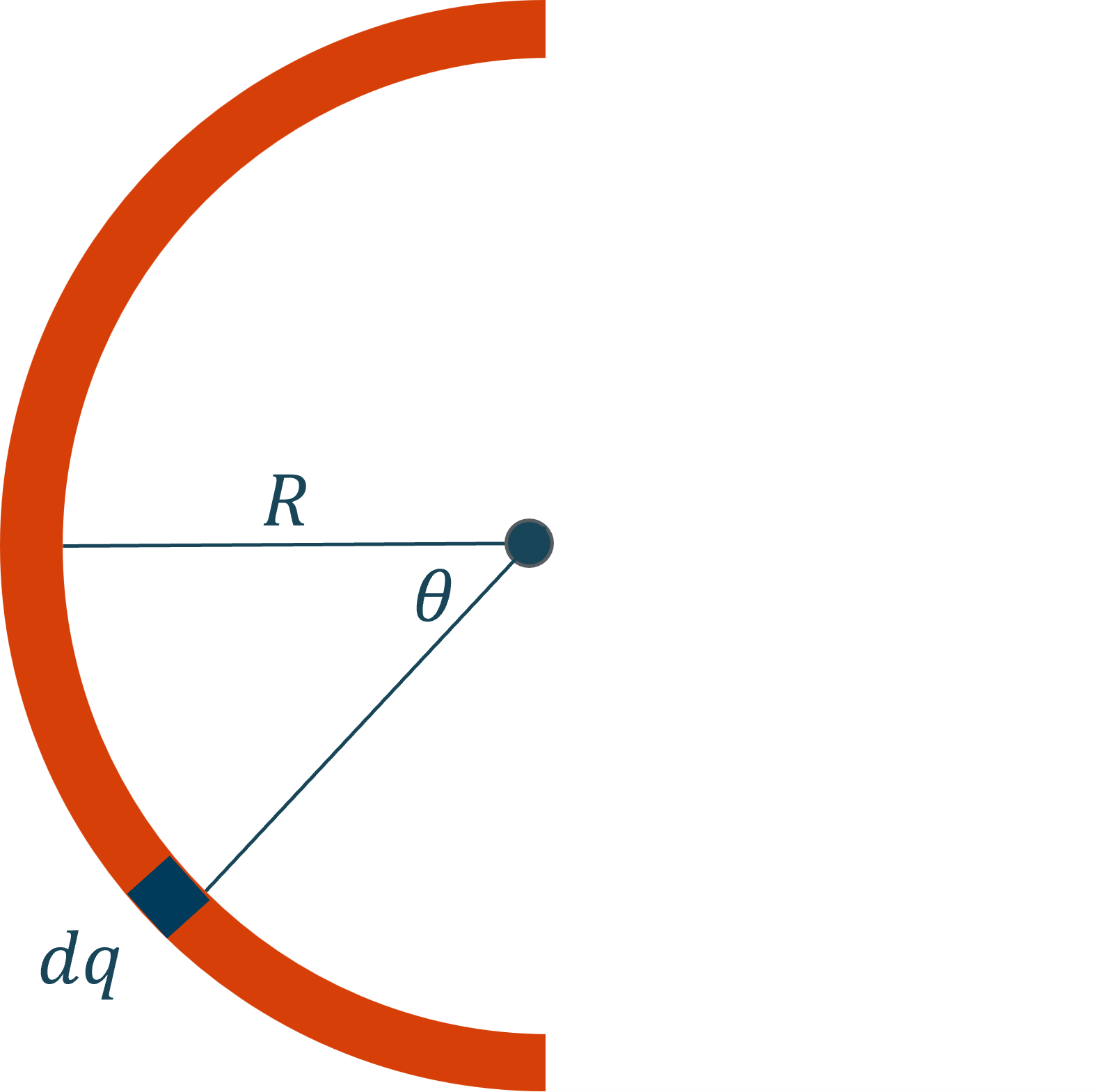
A uniformly charged semi-circular wire has radius \(R\) has a total charge \(+Q\text{.}\)
A semicircle starting at the top and moving counterclockwise to the bottom.  dq is labeled near the bottom at an angle theta from the horizontal.
Figure 22.8.1. A charged semicircular wire.

(a)

Chop: In the previous activity, you chopped the semicircle first into six small pieces and then into infinitesimally small pieces. If you do not have one already, write an equation that relates \(dq\) and \(d\theta\text{.}\)

(b)

Multiply: What is the electric field \(\vec{dE}\) at the center of the circle due to the segment of the wire that covers a very small angle \(d\theta\text{?}\)

(c)

Add: What is the net electric field at the center of the circle? What direction does it point? Does your answer make sense?

(d)

Compare your result to the answer you got when you only chopped the wire up into six discrete pieces.
