Section 26.2 The Loop and Junction Rules
Subsubsection Key Ideas
Principle 26.2.2. The Loop Rule.
The Loop Rule requires that the voltages around a complete loop add to zero:
\begin{equation*}
\sum V = 0
\end{equation*}
It is common to write the voltage across a circuit element as \(V\) rather than \(\Delta V\text{;}\) however, \(V\) still represents a potential difference.
The Loop Rule is a consequence of the Path Independence of \(\Delta V\text{.}\) You will see in the chapter on Faraday’s Law how to approach the case where \(\Delta V\) is not path independent.
Principle 26.2.3. The Junction Rule.
The Junction Rule requires that the sum of the incoming currents at any junction must equal the sum of the outgoing currents:
\begin{equation*}
\sum I_{\mathrm{in}} = \sum I_{\mathrm{out}}
\end{equation*}
In any part of a circuit with no junctions, the current is equal.
The Junction Rule is a consequence of conservation of charge in each part of a circuit. At any point where the junction rule does not hold, there would be an accumulation of charge, which would naturally give rise to additional electric fiels that would undo that accumulation of charge.
Historical Note 26.2.4. Kirchoff’s Laws.
The Loop Rule and The Junction Rule form the basis for analyzing all circuits. Together, the two rules are sometimes known as Kirchhoff’s Laws after the German physicist and mathematician Gustav Kirchhoff.
Subsubsection Activities
Activity 26.2.1. Using the Loop and Junction Rules.
Recall the Going around a Circuit activity from the previous section. Apply the loop rule and the junction rule to that circuit. How do your answers compare with what you now know about the loop rule and the junction rule?
Answer.
The voltages must add to zero, so you need another voltage decrease across element C of
\begin{equation*}
\Delta V_C = - 2 \mathrm{~V}
\end{equation*}
There are no junctions in this circuit, so the current in all three circuit elements will be equal:
\begin{equation*}
I_B = I_C = 0.7 \mathrm{~A}
\end{equation*}
Activity 26.2.2. Negative Current.
One of your friends builds a circuit and measures a negative current through one of the light bulbs in their circuit. What do you think the negative means for current?
Activity 26.2.3. Combining Currents.
Shown below is part of a circuit where two wires combine into one wire.
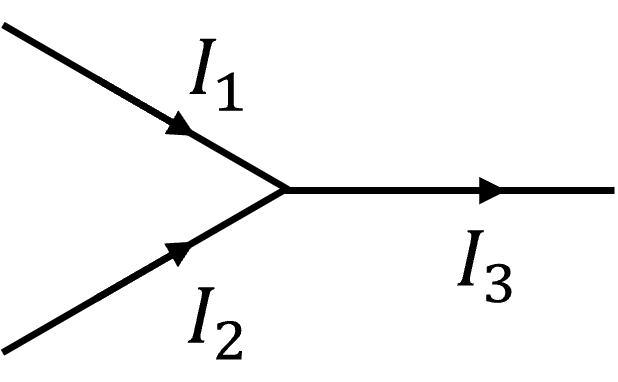
Which of the following describes the current in the third wire? Explain your reasoning.
-
\(\displaystyle I_3 = I_1 + I_2\)
-
\(\displaystyle I_3 = I_1 \times I_2\)
-
\(\displaystyle I_3 = I_1 - I_2\)
-
\(\displaystyle \frac{1}{I_3} = \frac{1}{I_1} + \frac{1}{I_2}\)