Skip to main content \(\newcommand{\N}{\mathbb N}
\newcommand{\Z}{\mathbb Z}
\newcommand{\Q}{\mathbb Q}
\newcommand{\R}{\mathbb R}
\newcommand{\lt}{<}
\newcommand{\gt}{>}
\newcommand{\amp}{&}
\definecolor{fillinmathshade}{gray}{0.9}
\newcommand{\fillinmath}[1]{\mathchoice{\colorbox{fillinmathshade}{$\displaystyle \phantom{\,#1\,}$}}{\colorbox{fillinmathshade}{$\textstyle \phantom{\,#1\,}$}}{\colorbox{fillinmathshade}{$\scriptstyle \phantom{\,#1\,}$}}{\colorbox{fillinmathshade}{$\scriptscriptstyle\phantom{\,#1\,}$}}}
\)
Section 17.13 Intensity Patterns
Subsubsection Warm-up Activities
Activity 17.13.1 . Intensity to Loudness.
How loud is a noise that has an intensity of
\(I = 100 I_0\text{?}\)
Activity 17.13.2 . Speaking to a Friend.
Speaking to your friend involves sound at about 60 dB. How much bigger is the intensity of a sound at 80 dB?
Activity 17.13.3 . The Vacuum Cleaner.
If a vacuum cleaner makes a sound of 75 dB from a distance of 1 m away, how far away must you stand from the vacuum cleaner for the sound to drop to a level of 25 dB (a whisper)?
Hint .
Write a symbolic expression for the sound level in terms of the distance from the source.
Subsubsection Intensity Pattern Activities
Activity 17.13.4 . Sound Detectors.
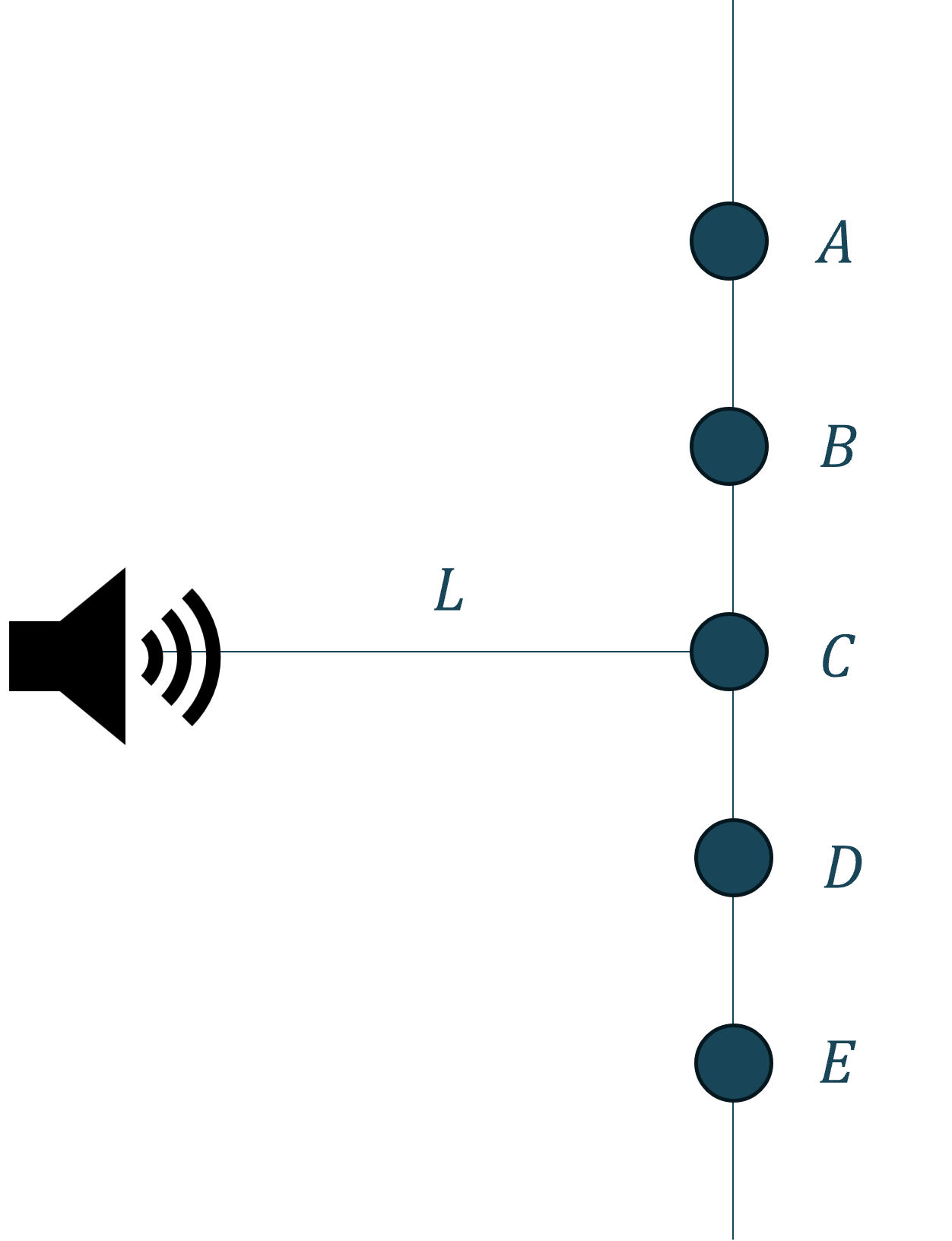
A source produces a sound with power P. It sits across from a wall of sound detectors a distance
\(L\) away, as shown below. The sound detectors are separated from each other by a distance
\(s\text{.}\)
Figure 17.13.1. Five speakers near a source of sound waves.
(a) Which speaker(s) will detect the loudest sound?
(b) Which speaker(s) will detect the faintest sound?
(c) Determine a symbolic expression for the intensity of the sound at point A.
(d) What if the wall was made up of an infinite number of detectors? What would a graph of the intensity vs. vertical position look like?