Skip to main content \(\newcommand{\N}{\mathbb N}
\newcommand{\Z}{\mathbb Z}
\newcommand{\Q}{\mathbb Q}
\newcommand{\R}{\mathbb R}
\newcommand{\lt}{<}
\newcommand{\gt}{>}
\newcommand{\amp}{&}
\definecolor{fillinmathshade}{gray}{0.9}
\newcommand{\fillinmath}[1]{\mathchoice{\colorbox{fillinmathshade}{$\displaystyle \phantom{\,#1\,}$}}{\colorbox{fillinmathshade}{$\textstyle \phantom{\,#1\,}$}}{\colorbox{fillinmathshade}{$\scriptstyle \phantom{\,#1\,}$}}{\colorbox{fillinmathshade}{$\scriptscriptstyle\phantom{\,#1\,}$}}}
\)
Section 24.7 Application: Charged Wire Potential
Activity 24.7.1 . Warmup Ranking.
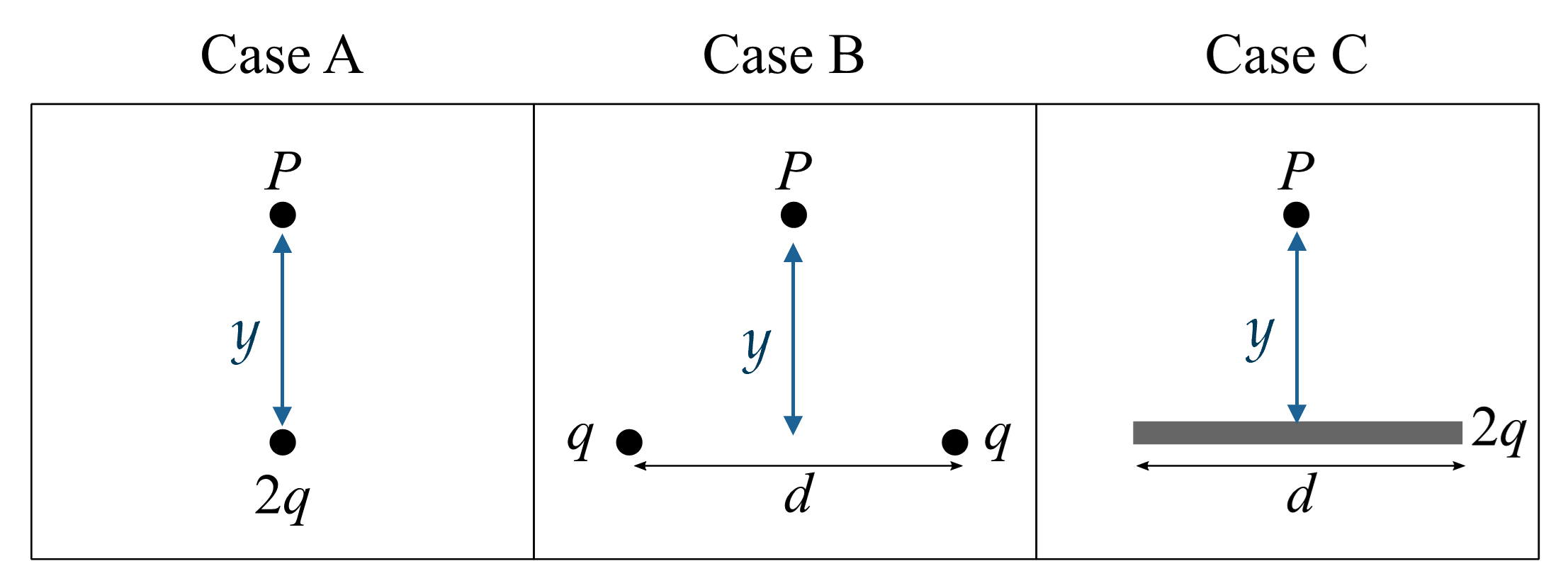
Consider the three charge distributions below.
Figure 24.7.1. Three charge distributions.
(a)
Predict: Rank the three cases by the value of the electric potential at point P from greatest to least. Explain how you determined your answer.
(b) Determine the value of the electric potential at point P in case A and case B.
Activity 24.7.2 . Potential of the Wire.
Set up an integral to find the value of the electric potential at point C using our strategy for dealing with continuous charges:
(a)
Chop the wire into
\(dq\) pieces. Identify
\(r\text{.}\)
(b)
Multiply to find the
\(dV\) created by each piece.
(c)
Add to find the total potential.
(d)
Challenge: Set up an integral to find the electric potential a distance
\(z\) above a rectangular plate (width
\(2a\) and length
\(2b\) centered on the origin) with surface charge density
\(+\sigma\text{.}\)
Solution .
Chop:
\begin{equation*}
\sigma = \frac{dq}{dA}
\end{equation*}
\begin{equation*}
dq = \sigma dA = \sigma dx dy
\end{equation*}
Multiply:
\begin{equation*}
dV = \frac{kdq}{r} = \frac{k\sigma dx dy}{\sqrt{x^2 + y^2 + z^2}}
\end{equation*}
Add:
\begin{equation*}
V = \int dV = \int_{-b}^b \int_{-a}^a \frac{k\sigma dx dy}{\sqrt{x^2 + y^2 + z^2}}
\end{equation*}