Section 26.3 Ideal Batteries and Wires
Subsubsection Key Ideas
Essential to analyzing circuits is to have a model for the voltage across each possible circuit element, starting with ideal batteries and ideal wires.
Definition 26.3.2. Battery.
A battery is a circuit element that provides a source of voltage.
-
There is a voltage difference between the terminals of a battery. The \(+\) terminal of the battery is at a higher voltage than the \(-\) terminal.
-
A battery stores chemical potential energy. When the battery is part of a complete circuit, the chemical energy is converted to electric potential energy by separating charged ions in a chemical solution.
-
The separated ions create an electric field. When the battery is part of a complete circuit, an electric field exists in both the battery and in the conductors that make up the circuit. These conductors are thus not in electrostatic equilibrium.
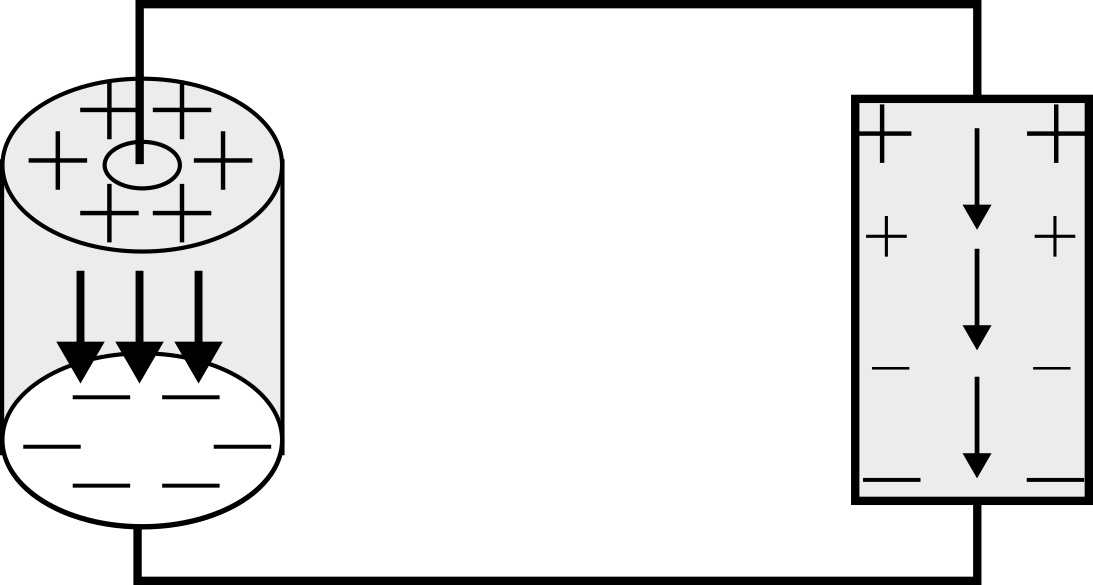
Assumption 26.3.4. Ideal Battery.
An ideal battery has a constant voltage that does not change in time and is not dependent on what the battery is connected to. The voltage is higher at the positive end of the battery.
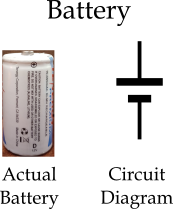
Assumption 26.3.6. Ideal Wire.
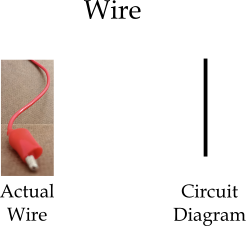
An ideal wire has no effective resistance to the flow of current, and the voltage across it is always equal to zero. Metal objects that are good electrical conductors (such as copper) make good ideal wires.
Subsubsection Activities
Activity 26.3.1. Properties of Ideal Batteries and Wires.
Which of the following statements are true?
-
When the battery is in a complete circuit, it is in electrostatic equilibrium
-
The positive terminal of the battery is at a higher voltage than the negative terminal of the battery
-
The negative terminal of the battery always has a voltage equal to zero
-
The voltage across an ideal wire is equal to zero

