Section 28.7 Lenz’s Law
Principle 28.7.2. Lenz’s Law.
You have now seen some examples of Magnetic Induction, in which a current is induced in a conducting loop by a changing magnetic flux.
An induced current creates a magnetic field that always opposes the change in magnetic flux.
\begin{equation*}
I_{\text{induced}} \propto - \frac{\partial \Phi_B}{\partial t}
\end{equation*}
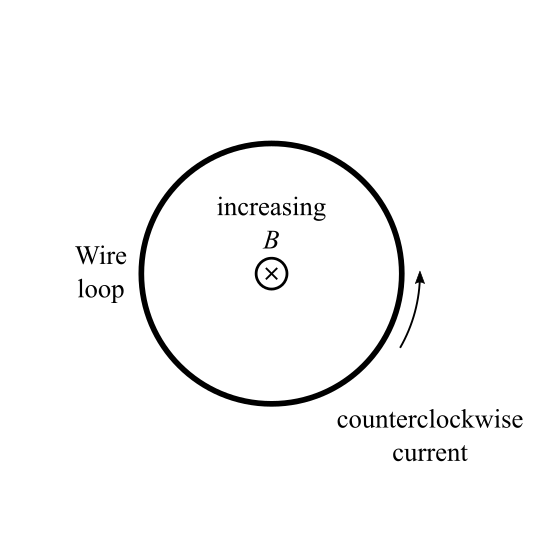
Representation 28.7.4. Magnetic Induction Table.
A magnetic induction table is a representation that helps you organize and keep track of the various quantities related to magnetic induction. An example table for the situation in the Induced Current Figure is shown below. In the example, a magnetic field points into the screen with increasing magnitude.
| Quantity | Direction or Sign |
|---|---|
| \(\vec{A}\) | in |
| \(\vec{B}\) | in |
| \(\Phi_B\) | \(+\) |
| \(\frac{d\Phi_B}{dt}\) | \(+\) |
| \(I_{ind}\) | ccw |
| \(\vec{\mu}_{ind}\) | out |
Subsubsection Activities
Activity 28.7.1. Cause of Induction.
In the example above, what force do you think is causing the charges that make up the current to move?
Activity 28.7.2. Moving Current Loop.
The current-carrying wire below is being pulled downward, away from the square metal loop.

(a)
As the wire is moving, is the induced current around the loop clockwise, counterclockwise, or zero? Create a magnetic induction table to explain your reasoning.
(b)
Describe a different experiment you could do with the setup in the figure that would result in an induced current in the loop. What direction will the current in the loop be for your experiment, and why?

