Skip to main content \(\newcommand{\N}{\mathbb N}
\newcommand{\Z}{\mathbb Z}
\newcommand{\Q}{\mathbb Q}
\newcommand{\R}{\mathbb R}
\newcommand{\lt}{<}
\newcommand{\gt}{>}
\newcommand{\amp}{&}
\definecolor{fillinmathshade}{gray}{0.9}
\newcommand{\fillinmath}[1]{\mathchoice{\colorbox{fillinmathshade}{$\displaystyle \phantom{\,#1\,}$}}{\colorbox{fillinmathshade}{$\textstyle \phantom{\,#1\,}$}}{\colorbox{fillinmathshade}{$\scriptstyle \phantom{\,#1\,}$}}{\colorbox{fillinmathshade}{$\scriptscriptstyle\phantom{\,#1\,}$}}}
\)
Section 28.6 Flux and Induction
Activity 28.6.1 . Flux Loops.
A square loop (side length \(s\) ) in the plane of the screen is in a region of magnetic field. Find the magnetic flux through the loop if:
The magnetic field is a uniform
\(B_o\) and points into the screen.
The magnetic field is a uniform
\(B_o\) and points to the right.
The magnetic field points into the screen and increases linearly from
\(0\) along the left edge to
\(B_o\) along the right edge.
Activity 28.6.2 . The Pickup Coil.
(a) Play with the simulation for a few minutes. Record a list of observations.
(b) How many different kinds of changes can you make that will cause the light bulb to light up?
(c) Consider the statement: “While the magnetic flux through the loop changes, there is current induced in the loop.” What evidence is there to support this statement? Can you find any evidence to refute the statement? Can you find any evidence that suggests the statement is incomplete?
(d) Identify what properties the induced current in the loop depends on. Justify your answers with evidence from the simulation.
Activity 28.6.3 . Force on a Circuit.
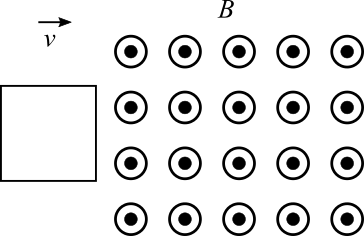
The figure below shows a small, square conducting loop with side length
\(s\) being pushed to the right at constant speed
\(v\) toward a region of uniform magnetic field
\(B\) pointing outward.
Figure 28.6.1. A square loop moving into a magnetic field.
(a) Choose an area vector for the wire loop. Use the right-hand rule to determine whether a clockwise current in the loop is positive or negative.
(b) Consider a positive charge located somewhere in the wire. Will this positive charge experience a magnetic force? If so, what direction?
(c) Predict whether or not the force you identified above will be able to drive a current through the loop during each of the following intervals:
As the loop is entering the field.
While the loop is entirely within the field.
As the loop is exiting the field.
(d) Sketch and label a graph of the magnetic flux
\(\Phi_B\) as a function of time.
(e) Sketch and label a graph of the current through the loop as a function of time.
Definition 28.6.2 . Magnetic Induction.
A changing magnetic flux through a conducting loop will
induce a current!
\begin{equation*}
I_{\text{induced}} \propto - \frac{\partial \Phi_B}{\partial t}
\end{equation*}