Skip to main content \(\newcommand{\N}{\mathbb N}
\newcommand{\Z}{\mathbb Z}
\newcommand{\Q}{\mathbb Q}
\newcommand{\R}{\mathbb R}
\newcommand{\lt}{<}
\newcommand{\gt}{>}
\newcommand{\amp}{&}
\definecolor{fillinmathshade}{gray}{0.9}
\newcommand{\fillinmath}[1]{\mathchoice{\colorbox{fillinmathshade}{$\displaystyle \phantom{\,#1\,}$}}{\colorbox{fillinmathshade}{$\textstyle \phantom{\,#1\,}$}}{\colorbox{fillinmathshade}{$\scriptstyle \phantom{\,#1\,}$}}{\colorbox{fillinmathshade}{$\scriptscriptstyle\phantom{\,#1\,}$}}}
\)
Section 26.6 Circuit Loops
Activity 26.6.1 . Combinations of Light Bulbs.
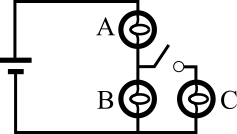
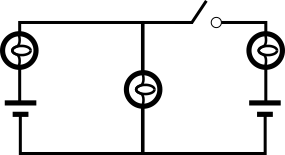
Predict how bulbs A and B will change in brightness when we close the switch!
Figure 26.6.1. A circuit diagram.
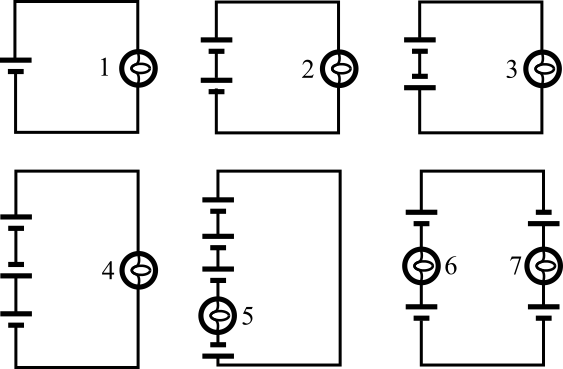
(a) Identify any bulbs that are in series or in parallel. Sketch voltage diagrams for each branch in both circuits. Rank all six bulbs by brightness.
Figure 26.6.2. Two circuit diagrams. (b) Consider the circuits below one at a time. For each new circuit, use voltage diagrams to predict how the brightness of each bulb compares to the bulbs in the previous circuits. After you make your predictions, use the simulation to check your predictions! Modify your diagrams based on your observations, if necessary
Figure 26.6.3. Six circuit diagrams.
Activity 26.6.2 . Complicated Loops.
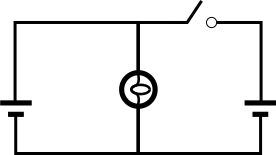
Predict whether the brightness of the light bulb will increase, decrease, or remain the same when the switch is closed.
Figure 26.6.4. A circuit diagram.
(a) Why do you think the upper circuit behaves the way it does? How does the current through each battery change?
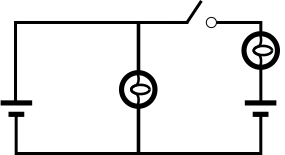
Figure 26.6.5. Two circuit diagrams. Predict what will happen to each light bulb in the bottom circuit when you close the switch.
Construct this circuit in the simulation and check your predictions.
If you have not already done so, draw voltage diagrams for this circuit. Make sure your diagrams agree with your observations!
(b) When the switch is closed:
Predict the relative brightness of the three light bulbs. Explain.
Construct this circuit in the simulation and check your predictions.
If you have not already done so, draw voltage diagrams for this circuit. Make sure your diagrams agree with your observations!
Figure 26.6.6. A circuit diagram. When you open the switch:
Predict how (if at all) the brightness of each light bulb will change. Explain.
Construct this circuit in the simulation and check your predictions.
If you have not already done so, draw voltage diagrams for this circuit. Make sure your diagrams agree with your observations!
Propose a modification to one of the circuits you have explored today. Make a prediction and then test it out using the simulation!