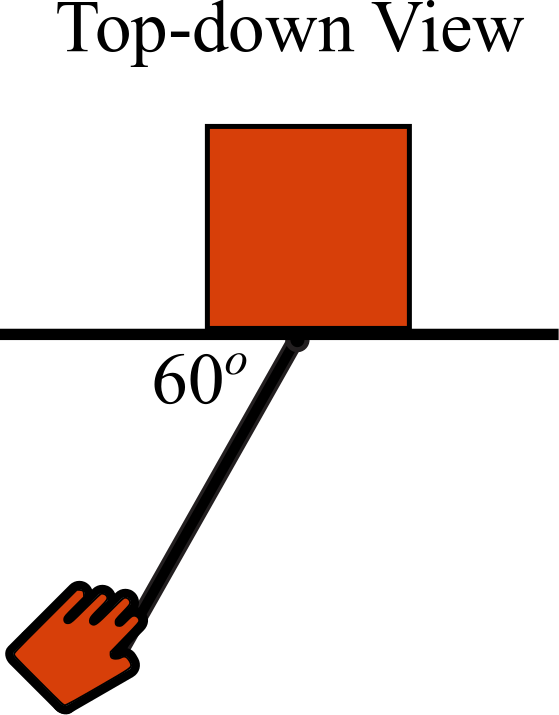
A small brick of mass \(0.8 \mathrm{~kg}\) is positioned against a horizontal wooden railing. You pull on the rope at the \(60^o\) angle shown so that the acceleration of the brick is \(2 \mathrm{~m/s^2}\) to the left. Find the magnitudes of all forces on the brick.
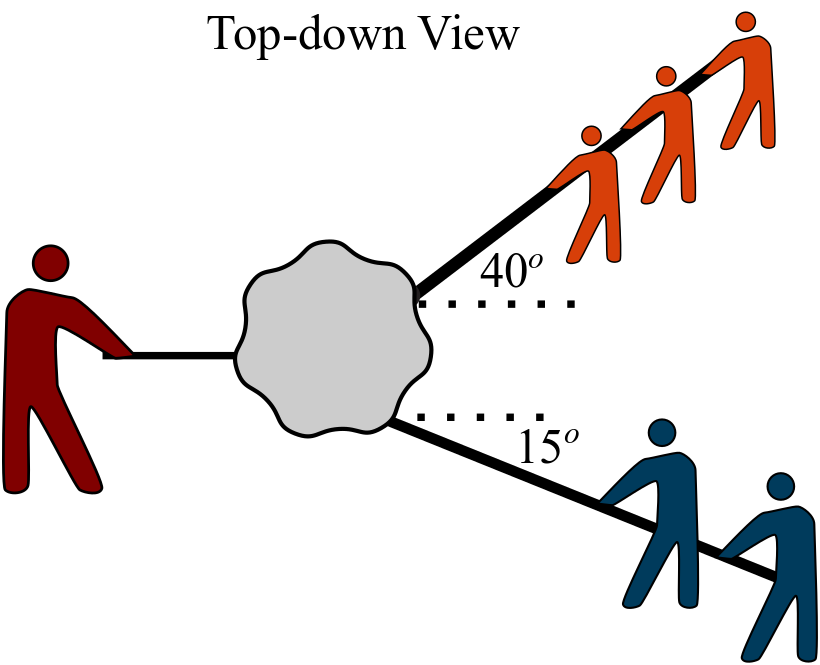
The figure below shows a top-down view of a tug-of-war between a coach (in red on the left) and two teams of “student-athletes”. The coach can pull with a force of \(1500 \mathrm{~N}\text{,}\) and the two teams together are just able to keep the rock connected to the ropes from beginning to accelerate. Determine the magnitude of the tension force provided by each of the two teams.
Analyze and Represent: Sketch a free-body diagram for the situation. Think carefully about what reference frame you want to choose and break each force into components.
Calculate: Remember that your answer and work should be primarily symbolic. Choosing good symbols for both known and unknown quantities (including the angles!) can help support both your algebra and your sensemaking.