Skip to main content \(\newcommand{\N}{\mathbb N}
\newcommand{\Z}{\mathbb Z}
\newcommand{\Q}{\mathbb Q}
\newcommand{\R}{\mathbb R}
\newcommand{\lt}{<}
\newcommand{\gt}{>}
\newcommand{\amp}{&}
\definecolor{fillinmathshade}{gray}{0.9}
\newcommand{\fillinmath}[1]{\mathchoice{\colorbox{fillinmathshade}{$\displaystyle \phantom{\,#1\,}$}}{\colorbox{fillinmathshade}{$\textstyle \phantom{\,#1\,}$}}{\colorbox{fillinmathshade}{$\scriptstyle \phantom{\,#1\,}$}}{\colorbox{fillinmathshade}{$\scriptscriptstyle\phantom{\,#1\,}$}}}
\)
Section 28.5 Current Loops
Activity 28.5.1 . Magnetic Dipoles.
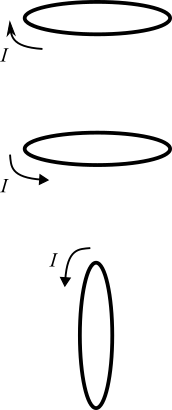
For each of the current loops shown below:
Figure 28.5.1. Three current loops.
(a) Use the right-hand rule to determine the magnetic dipole moment of the loop.
(b) Sketch and label a small bar magnet that would have the same magnetic dipole moment as the loop.
Activity 28.5.2 . Dipole Energy.
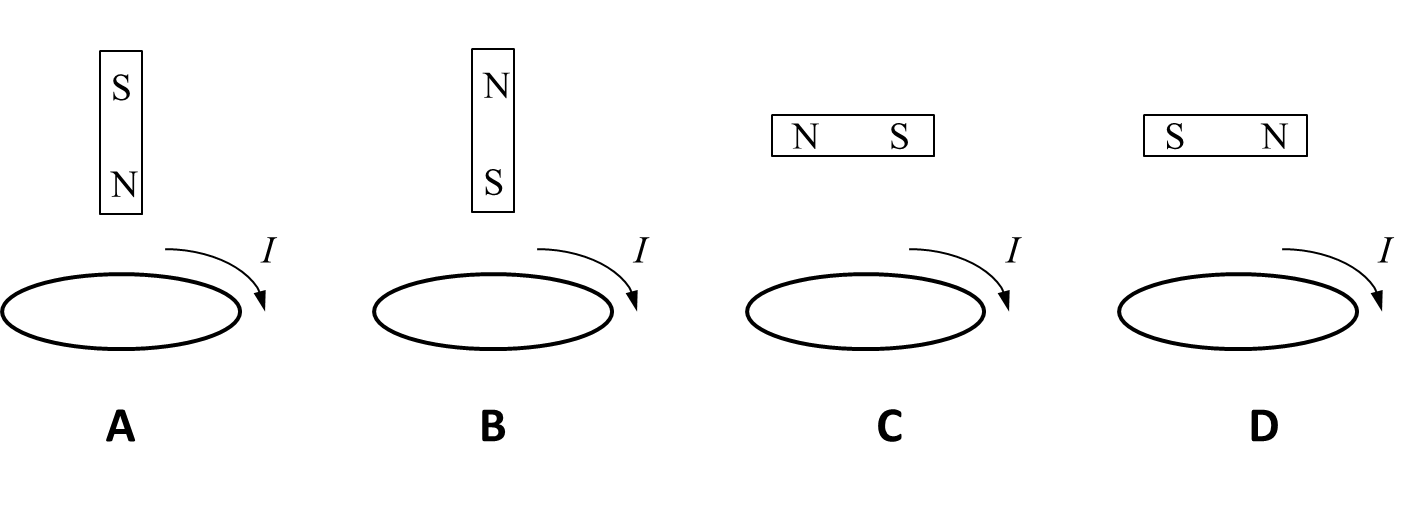
Rank the configurations below from smallest to largest potential energy. Check that your ranking makes sense by figuring out what the magnet is likely to do in each situation.
Figure 28.5.2. Four magnet configuration.