Activity 18.5.1. Wave Boundaries.
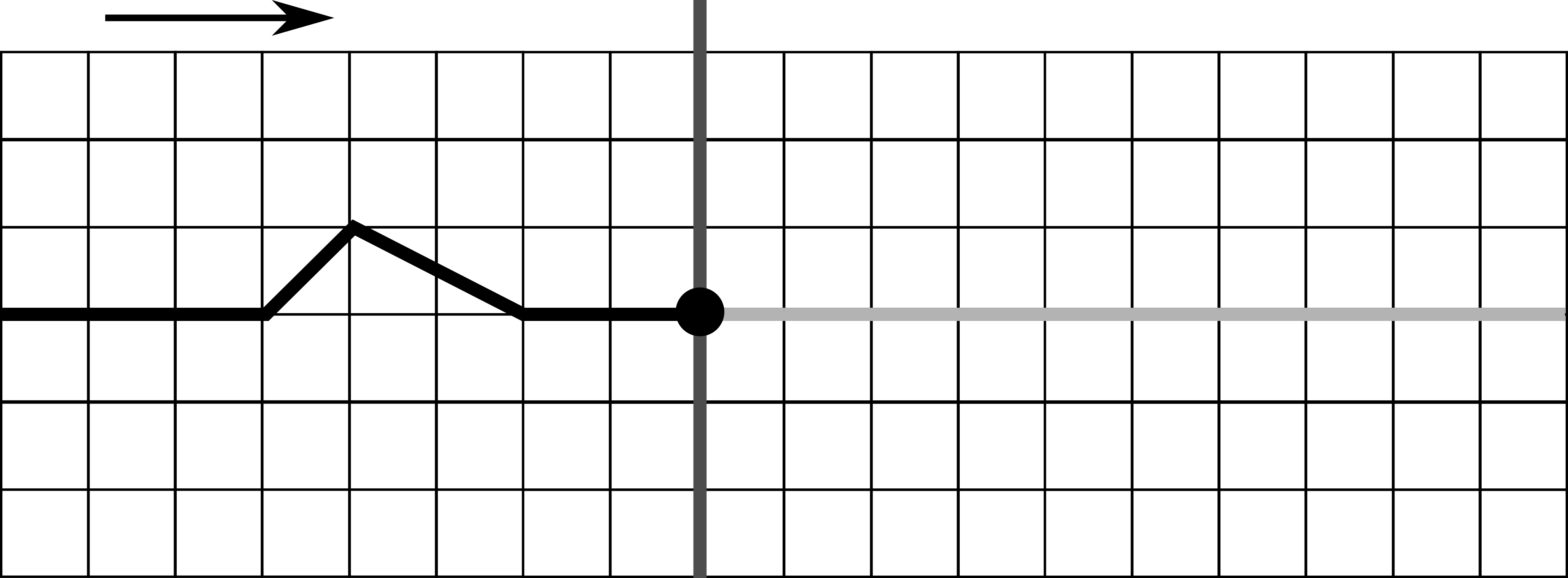
Shown below is a wave pulse that is moving toward a point of the spring that is fixed (tied down so that it cannot move), represented by a dot. Note that the right side of the image is imaginary (there is no real spring there).
(a)
Sketch another wave pulse on the imaginary side of the figure that has the following features:
-
It has the same general shape as the incident pulse.
-
It is mirrored (reflected over the vertical line passing through the dot).
-
It is inverted (reflected over the horizontal).
-
It is moving to the left.
(b)
Show that, as these two pulses pass each other, the superposition of the two pulses leaves the dot fixed.
(c)
Sketch the shape of the spring at some instant after the two pulses have completely passed each other.
(d)
Suppose the same pulse is incident on a point of the spring that is free to move up and down, represented by the same dot.
Sketch another wave pulse on the imaginary side of the figure that has the following features:
-
It has the same general shape as the incident pulse.
-
It is mirrored (reflected over the vertical line passing through the dot).
-
It is not inverted.
-
It is moving to the left.
(e)
Sketch the shape of the spring at a few different instants as the pulses pass each other. What do you notice about the shape of the spring near the free end?
(f)
Sketch the shape of the spring at some instant after the two pulses have completely passed each other.

