Section 11.3 Plane Mirrors
Subsubsection Key Ideas
Definition 11.3.2. Images.
An image is a phenonemon where a collection of light rays that begin at a physical object interact with optical devices in such a way that they diverge from a location that is different from the position of the object, giving the appearance of an object at a location where that object is not actually located.
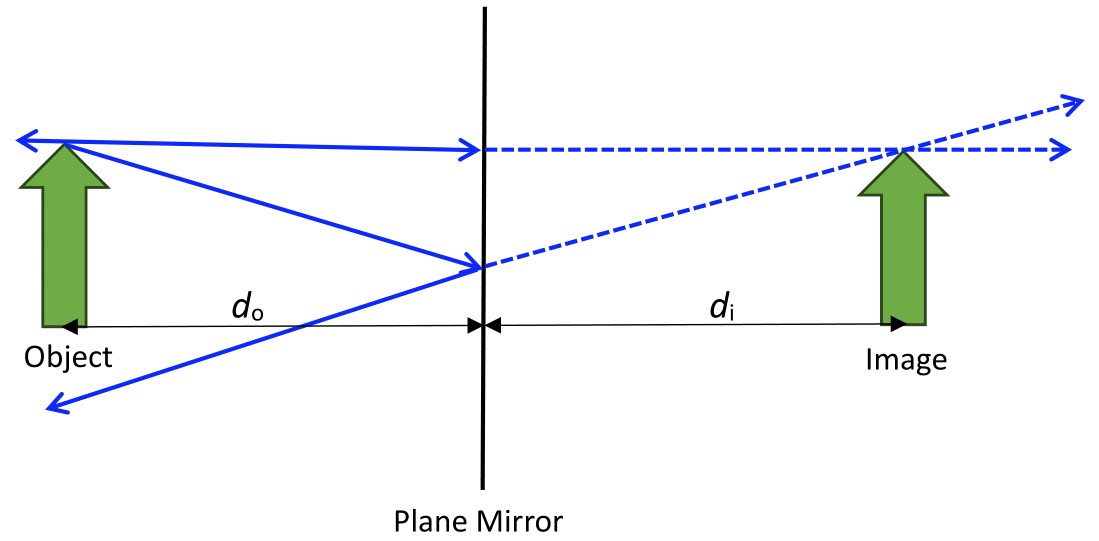
Principle 11.3.4. Image Distance - Flat Mirrors.
Measuring from the surface of a flat mirror, the distance of an object to the mirror is equal to the negative of the distance of the image to the mirror: \(d_o = -d_i\text{.}\) The negative indicates that the image is in the opposite direction of the object (“behind” the mirror).
In this situation, you are seeing a virtual image. Virtual images are produced when light rays do not physically travel to the image location. When you are looking at yourself in a mirror, there is no physical copy of yourself behind the mirror. The image that you see is virtual. When you are looking at ray diagrams of mirrors and lenses, you are typically interested in figuring out where the image is located.
Definition 11.3.5. Real and Virtual Images.
A real image is created when light rays form an image by traveling through the image location.
A virtual image is created when light rays form an image but do not travel through the image location.
Subsubsection Plane Mirror Activities
Activity 11.3.1. Mirror Illusion.
Watch this video about a “mirror illusion”.
Answer the following questions:
-
What is the illusion here?
-
Draw a ray diagram to explain how you can still see the object in the mirror.
-
How would you explain this to someone that does not know anything about the ray model for light and reflections?
References References
[1]
“HOW does the MIRROR know this? 😳😨 #Shorts.” YouTube, uploaded by Cam Casey, 7 April 2023, https://www.youtube.com/watch?v=gNgSlGn59xA&ab_channel=CamCasey

