Skip to main content \(\newcommand{\N}{\mathbb N}
\newcommand{\Z}{\mathbb Z}
\newcommand{\Q}{\mathbb Q}
\newcommand{\R}{\mathbb R}
\newcommand{\lt}{<}
\newcommand{\gt}{>}
\newcommand{\amp}{&}
\definecolor{fillinmathshade}{gray}{0.9}
\newcommand{\fillinmath}[1]{\mathchoice{\colorbox{fillinmathshade}{$\displaystyle \phantom{\,#1\,}$}}{\colorbox{fillinmathshade}{$\textstyle \phantom{\,#1\,}$}}{\colorbox{fillinmathshade}{$\scriptstyle \phantom{\,#1\,}$}}{\colorbox{fillinmathshade}{$\scriptscriptstyle\phantom{\,#1\,}$}}}
\)
Section 16.13 Representations of Damped Harmonic Motion
Subsubsection Activities
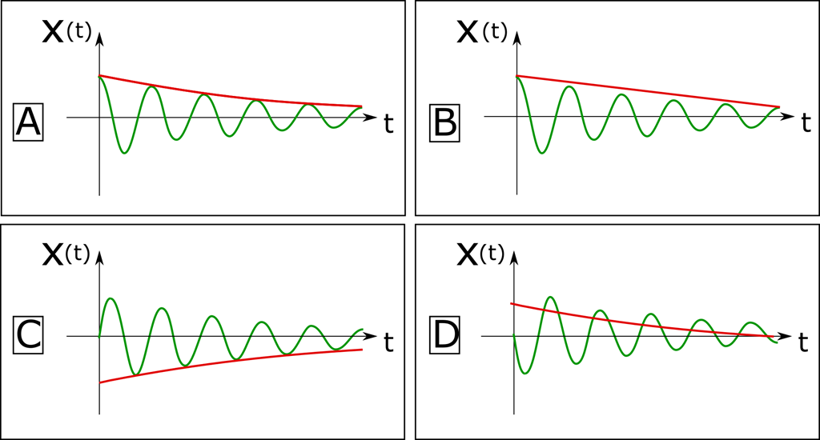
Activity 16.13.1 . Damped Block I.
A block is attached to an ideal spring. At
\(t = 0\text{,}\) the block-spring system, which has non-negligible air resistance, is released from rest at
\(x = 10 \mathrm{~cm}\text{.}\)
Which of the following graphs best represents both the position and amplitude functions for the block?
Figure 16.13.1. Possible graphs for damped harmonic motion.
Activity 16.13.2 . Damped Block II.
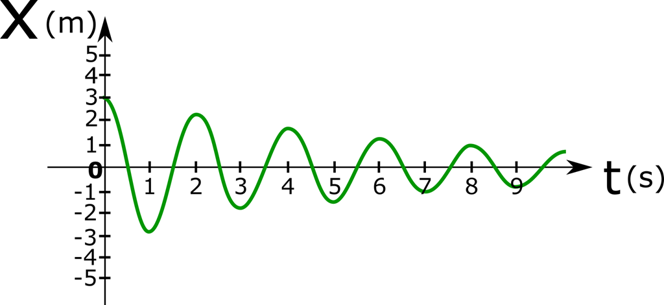
Suppose the graph below represents the displacement from equilibrium of another block attached to an ideal spring.
Figure 16.13.2. An example graph of damped harmonic motion.
(a) What’s the oscillator’s displacement at
\(t= 0 \mathrm{~s}\text{?}\)
(b) What is the amplitude at
\(t= 0 \mathrm{~s}\text{?}\)
(c) What is the displacement at
\(t= 2.5 \mathrm{~s}\text{?}\)
(d) What is the amplitude at
\(t= 2.5 \mathrm{~s}\text{?}\)
Hint .
You will need to determine
\(\tau\text{.}\)
References References
[1]
Activities adapted from BoxSand: https://boxsand.physics.oregonstate.edu/welcome.