Learning Introductory Physics with Activities

Section 23.9 Using Symmetry

Subsubsection Activities

Activity 23.9.1. Infinite Slab.

A charged wire with length \(L\) is oriented horizontally. The wire has a positive uniform charge density (the charge is spread out uniformly along the one-dimensional wire).
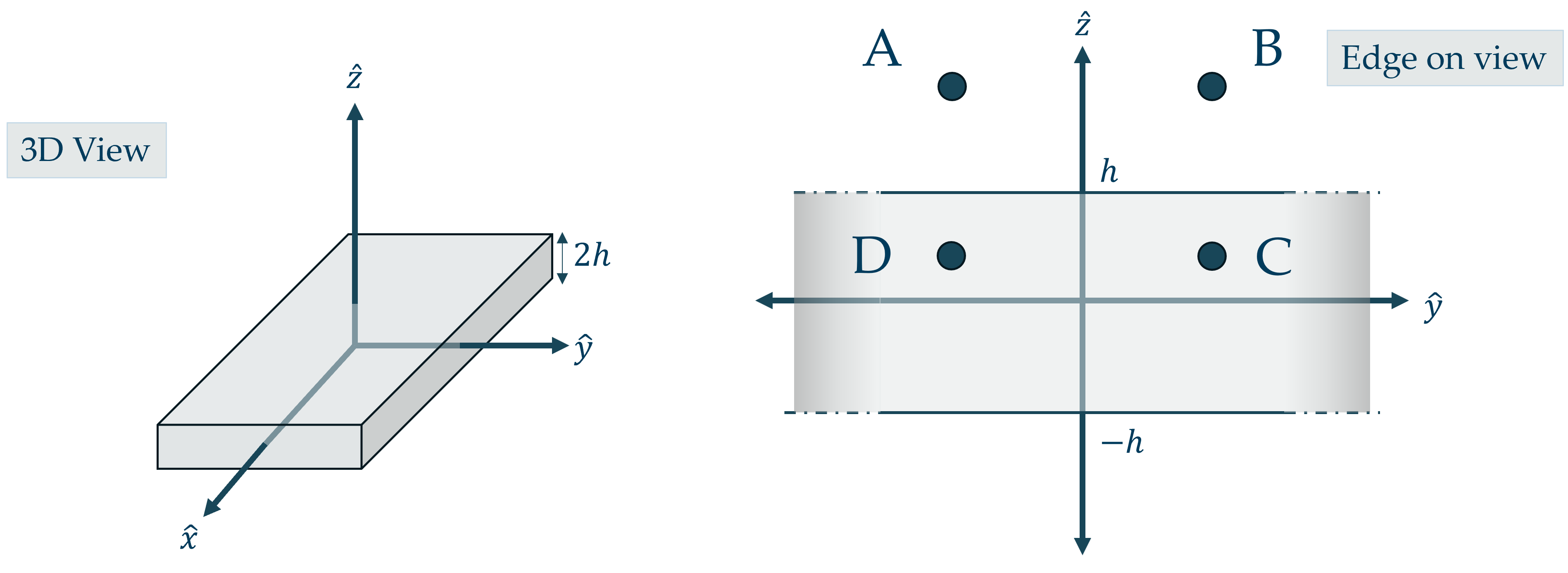
Left, a 3D view of a rectangular slab that occupies the entire xy-plane, extending through a z-height of 2h.  Right, an edge view of the yz-plane, showing a rectangular cross section of the slab, extending infinitely in the horizontal y direction and vertically from -h to h in the z direction.  Point A lies above the slab on the left, point B lies above the slab on the right, point C lies in the slab on the right, and point D lies in the slab on the left, the four points forming a rectangle.
Figure 23.9.1. Two views of a charged slab extending infinitely in the x- and y-directions.

(a)

Which direction should the electric field point?

(b)

How does the magnitude of the electric field at A and B compare? How does the magnitude of the electric field at C and D compare?

(c)

Which method should you use: Gauss’s Law or chop-multiply-add? How do you know?

(d)

Use the following steps, first for \(z \gt h\) (outside), and then for \(z \lt h\) (inside).
  1. Draw an appropriate Gaussian surface.
  2. Determine the enclosed charge.
  3. Write down the flux through each surface.
  4. Use Gauss’s Law to determine the magnitude of the electric field. Do not forget your direction!
Activity 23.9.2. Finite Slab.

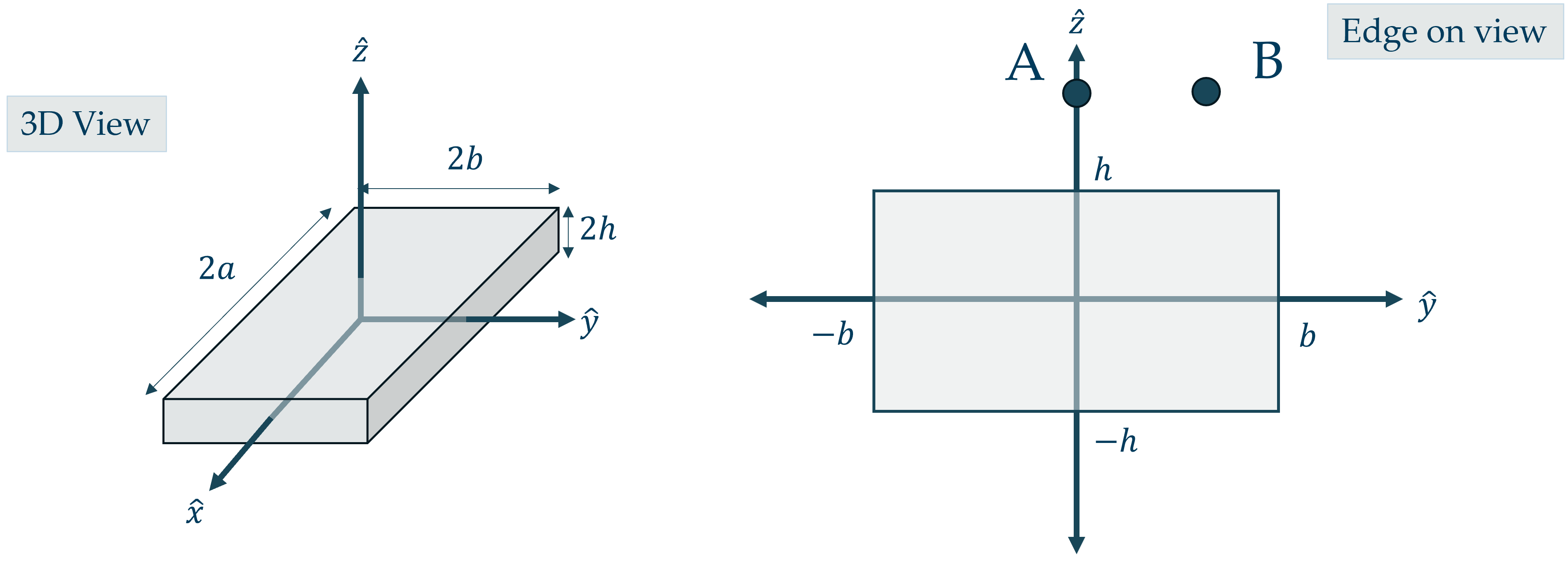
Suppose you have a finite slab of thickness \(2h\text{,}\) length \(2a\text{,}\) and width \(2b\text{,}\) with a uniform volume charge density \(\rho\text{.}\) You want to determine the electric field everywhere in space.
Left, a 3D view of a rectangular slab that has x-length 2a, y-width 2b, and z-height 2h.  Right, an edge view of the yz-plane, showing a rectangular cross section of the slab, extending horizontally in the y direction from -b to b and vertically from -h to h in the z direction.  Point A lies above the middle of the slab on the z-axis and point B lies horizontally to the right from point A.
Figure 23.9.2. Two views of a finite charged slab.

(a)

True or False: The direction of the electric field at point A and B is the same.
Answer.
False.

(b)

Try setting up an integral using chop-multiply-add for no more than five minutes before you click on the hint.
Hint.
Setting up this integral is extremely challenging, and evaluating it analytically is nearly impossible. Click the solution to see what it looks like!
Solution.
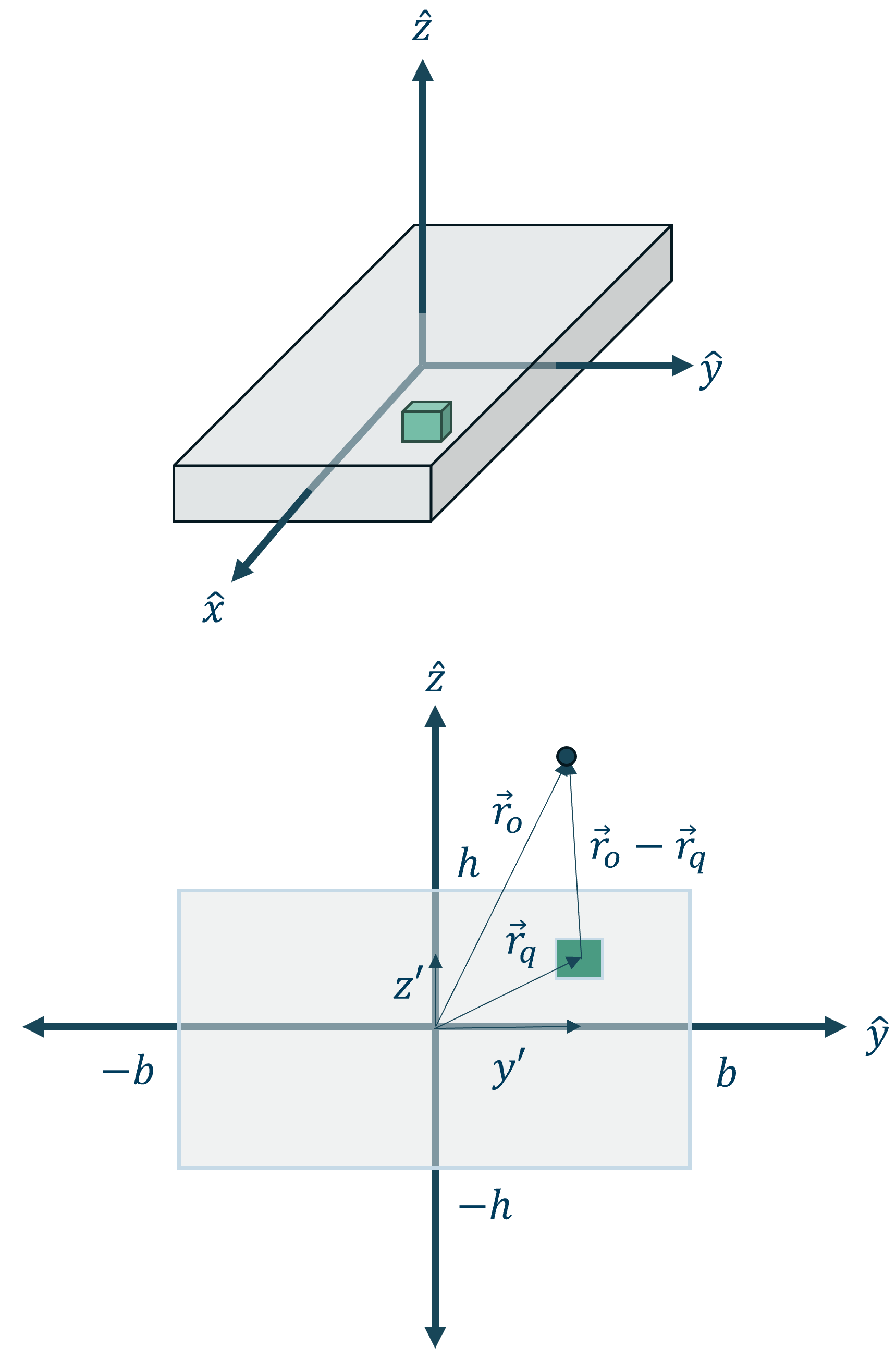
Top, a 3D view of a rectangular slab, with a small cube representing the infinitesimal piece.  Bottom, an edge view of the yz-plane, showing the small cube at position r prime and the position r where the field is to be evaluated.
Figure 23.9.3. Two views of an infinitesimal chunk of a finite charged slab.
\begin{equation*} \vec{E}(x,y,z) = k\rho\int_{-h}^h \int_{-b}^b \int_{-a}^a \frac{\left(x - x'\right)\hat{x} + \left(y - y'\right)\hat{y} + \left(z - z'\right)\hat{z}}{\left(\left(x - x'\right)^2 + \left(y - y'\right)^2 + \left(z - z'\right)^2\right)^{3/2}}dx'dy'dz' \end{equation*}
Calculating the electric field for any given charge distribution is in general non-trivial. This is why you try to apply any symmetry arguments before diving into the chop-multiply-add method.