Skip to main content \(\newcommand{\N}{\mathbb N}
\newcommand{\Z}{\mathbb Z}
\newcommand{\Q}{\mathbb Q}
\newcommand{\R}{\mathbb R}
\newcommand{\lt}{<}
\newcommand{\gt}{>}
\newcommand{\amp}{&}
\definecolor{fillinmathshade}{gray}{0.9}
\newcommand{\fillinmath}[1]{\mathchoice{\colorbox{fillinmathshade}{$\displaystyle \phantom{\,#1\,}$}}{\colorbox{fillinmathshade}{$\textstyle \phantom{\,#1\,}$}}{\colorbox{fillinmathshade}{$\scriptstyle \phantom{\,#1\,}$}}{\colorbox{fillinmathshade}{$\scriptscriptstyle\phantom{\,#1\,}$}}}
\)
Section 28.2 Torque on a Dipole
Previously, you considered the interaction between a
Current Loop and Tilted Bar Magnet . In this example, the bar magnet will end up
rotating as a result of the magnetic field created by the current loop. The concepts of
Torque and potential energy, which you have studied previously, can be used to help explain this interaction.
Definition 28.2.1 . Torque on a Magnetic Dipole Moment.
The torque on an object with a magnetic dipole moment \(\vec{\mu}\) due to a magnetic field \(\vec{B}\) is given by
\begin{equation*}
\vec{\tau} = \vec{\mu} \times \vec{B}
\end{equation*}
Definition 28.2.2 . Potential Energy for a Magnetic Dipole Moment.
A system consisting of an object with a magnetic dipole moment \(\vec{\mu}\) in a magnetic field \(\vec{B}\) has potential energy given by
\begin{equation*}
\vec{U} = - \vec{\mu} \cdot \vec{B}
\end{equation*}
Subsubsection Activities
Activity 28.2.1 . Rotating Magnet.
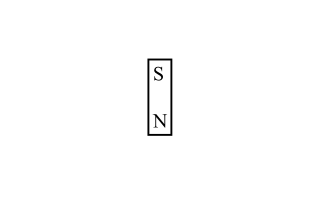
Consider the bar magnet shown below.
Figure 28.2.3. A bar magnet. Suppose you want the magnet to begin rotating counterclockwise. What direction should you put the magnetic field to achieve this effect?
Hint .
Remember that you would need a net torque out of the screen for the magnet to start rotating counterclockwise!