Activity 22.11.1. The Charged Wire.
A total charge \(+q\) is spread uniformly over a wire of length \(L\text{.}\) You want to determine the electric field at the indicated point.
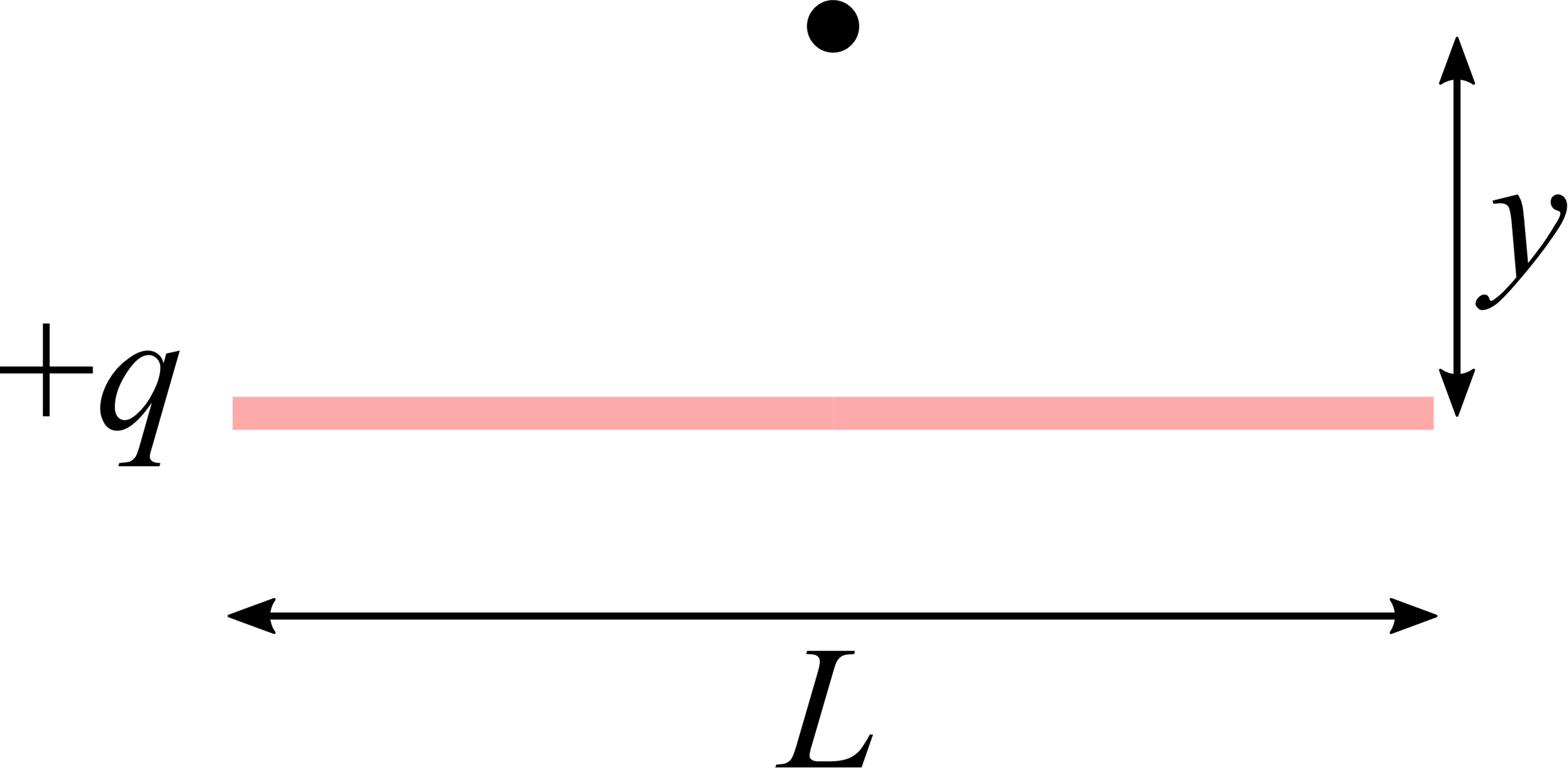
(a)
Predict: What direction do you expect the electric field to point? Do you expect its magnitude to be bigger, smaller or equal to \(\frac{kq}{y^2}\) ?
(b)
Chop the object up into pieces. Label at least one \(dq\) and identify relevant quantities. What is \(dq\) in terms of known quantities? What is \(r\text{?}\) What is \(\hat{r}\text{?}\)
(c)
Multiply the relevant quantities together to find \(\vec{dE}\text{.}\)
(d)
Add the \(\vec{dE}\) over the entire wire!
(e)
Make sense of your answer. Do the units check out? What happens as \(L \rightarrow 0\text{?}\) As \(y \rightarrow \inf\text{?}\) As \(y \rightarrow 0\)

