Recall Explanation - Three Cars. Answer this question again. As part of your explanation, discuss how your answer, your reasoning, or your understanding has changed since you first thought about this task.
In the two situations depicted below, an angled block is at rest on a ramp. In each case, a hand pushes on the block with constant force. In Case A, the hand pushes on the upper horizontal surface of the block. In Case B, the hand pushes on the upper angled surface with a constant force of the same magnitude. In both cases, the block remains at rest on the ramp.
Part B: Is the magnitude of the frictional force exerted on the block by the ramp in Case B greater than, less than, or equal to the magnitude of the frictional force in Case A?
For each A*R*C*S activity, you are expected to complete and label all of the A*R*C*S Steps. For your first A*R*C*S activity, each step will walk you through the A*R*C*S process. A simple example is provided in A*R*C*S Example: Rectangular Park II.
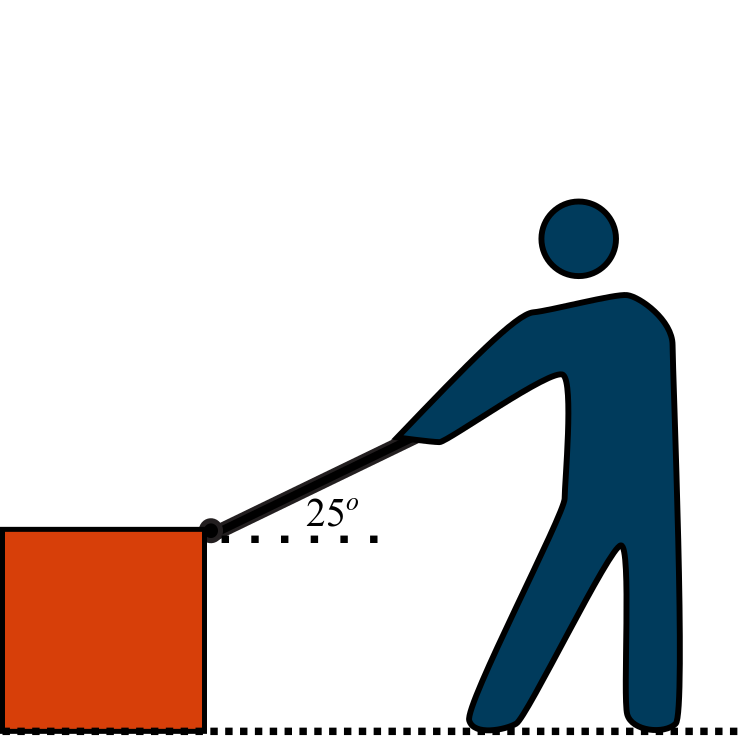
You are pulling a small, heavy block of mass \(40 \mathrm{~kg}\) across an icy lake. You pull on the rope at the angle shown in such a way that the normal force on the block by the ice is zero. Find the magnitude of the tension and the magnitude of the acceleration. Assume the gravitational force on the block points downward with a magnitude equal to \(mg\text{,}\) where \(m\) is the block’s mass and \(g = 10 \mathrm{~m/s^2}\text{.}\)
In 2-3 written paragraphs, discuss the similarities and differences between these two activities. Consider both the physical contexts and the overarching strategies you used to approach each context.