A*R*C*S 5.7.1. Uh-Oh Dr. Paws.
The instructor pushes a footstool (mass \(m_1\)) across the floor with a constant force so that the footstool speeds up. Dr. Paws (a dog with mass \(m_2\)) is sitting on the footstool. The coefficient of static friction between the dog and footstool is \(\mu\) (assume no friction with the ground).
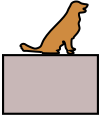
Determine how much force the instructor can exert on the footstool before the dog begins sliding.
(a) Analyze and Represent.
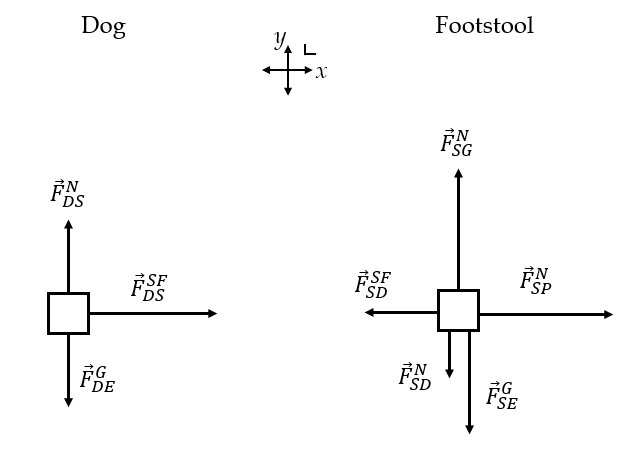
In the example that follows, describe why the assumptions are reasonable, identify all Action-Reaction (Newton’s 3rd Law) Pairs, and identify and fix the problems with the free-body diagrams.
-
List quantities.Mass of the footstool: \(m_1 = 10 \mathrm{~kg}\)Mass of the dog: \(m_2 = 30 \mathrm{~kg}\)Coefficient of static friction: \(\mu = 0.4\)Instructor force: \(F_i = ?\)
-
Identify assumptions.Near-earth: \(g = 10 \mathrm{~m/s^2}\text{;}\) particle-model; neglect air-resistance; no friction with the ground.
-
Represent the situation physically.
(b) Sensemake.
You have three friends who each calculate a different equation for the maximum allowable force the instructor can apply:
\begin{equation*}
F_{SP}^N = \mu \frac{𝑚_1}{𝑚_1 + 𝑚_2}g
\end{equation*}
\begin{equation*}
F_{SP}^N = \mu\left( 𝑚_2 - 𝑚_1 \right)g
\end{equation*}
\begin{equation*}
F_{SP}^N = \mu \frac{𝑚_1 𝑚_2}{(𝑚_1 + 𝑚_2}g
\end{equation*}
Use a sensemaking strategy to give a reason why each expression is incorrect.
(c) Calculate.
-
Represent physics principles that will help you solve for the tension and the acceleration.
-
Determine a symbolic equation for each unknown quantity in terms of known variables.
-
Plug numbers into your symbolic answer.

