Skip to main content \(\newcommand{\N}{\mathbb N}
\newcommand{\Z}{\mathbb Z}
\newcommand{\Q}{\mathbb Q}
\newcommand{\R}{\mathbb R}
\newcommand{\lt}{<}
\newcommand{\gt}{>}
\newcommand{\amp}{&}
\definecolor{fillinmathshade}{gray}{0.9}
\newcommand{\fillinmath}[1]{\mathchoice{\colorbox{fillinmathshade}{$\displaystyle \phantom{\,#1\,}$}}{\colorbox{fillinmathshade}{$\textstyle \phantom{\,#1\,}$}}{\colorbox{fillinmathshade}{$\scriptstyle \phantom{\,#1\,}$}}{\colorbox{fillinmathshade}{$\scriptscriptstyle\phantom{\,#1\,}$}}}
\)
Section 28.7 Magnetic Dipoles
Activity 28.7.1 . Warm-up Activity.
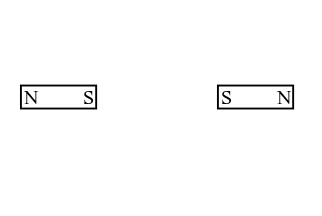
Shown below are two bar magnets. Describe how they will interact with one another. What will happen to their motion?
Figure 28.7.1. Two bar magnets sit side by side, with their south poles facing each other.
Video Lesson 28.7.2 . Magnetic Dipole Moment.
Bar magnets have a physical property called the magnetic dipole moment.
Definition 28.7.3 . Magnetic Dipole Moment.
The
magnetic dipole moment ,
\(\vec{\mu}\text{,}\) points from the south to the north pole inside a bar magnet.
The magnetic field around a simple magnetic dipole has the form shown below.
A bar magnet with a north and south pole. The field lines come out of the north pole and curve out and around to the south pole.Figure 28.7.4. Magnetic Field Lines of a bar magnet.
Subsubsection Activities
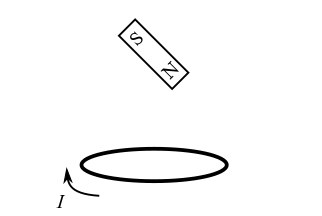
The figure below shows a bar magnet and a loop with current that is running clockwise when viewed from above.
Figure 28.7.5. A bar magnet sits above a loop of current that is running clockwise when viewed from above. The north pole is closest to the loop of current.
Activity 28.7.2 . Bar Magnet.
Describe what you expect to happen to the bar magnet and the loop as time progresses.
References References
[1]
“Magnetic Field Lines” modified from
OpenStax , https://openstax.org/books/university-physics-volume-2/pages/11-2-magnetic-fields-and-lines