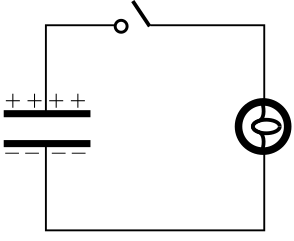
The circuit below contains a capacitor, an open switch, and a light bulb. The capacitor has known capacitance \(C_1\text{,}\) charge \(+Q\) on the top plate, and charge \(-Q\) on the bottom plate, as shown in the figure.
Suppose the switch is closed at \(t = 0\text{.}\) For an instant immediately after the switch is closed, sketch a voltage diagram for the circuit. How does the voltage across the light bulb compare to the voltage across the capacitor?
Give a qualitative description of what you think will happen to the following two quantities as time moves forward: (1) the charge on the capacitor and (2) the brightness of the light bulb. Support your answers with a mechanistic explanation.
Sketch a graph predicting the current through the circuit as a function of time, starting at \(t = 0\text{.}\) Comment on the value of the current in the limit as \(t \rightarrow \infty\text{.}\)
When a capacitor with initial charge \(Q_0\) and capacitance \(C\) is connected to a resistor with resistance \(R\text{,}\) the charge on the capacitor as a function of time is given by
Determine the units of the quantity \(RC\text{.}\) Describe how the graph you made would change if you were to increase this quantity. Use your answers to give a brief physical interpretation for it (that is, what kind of quantity is it, and what is it trying to tell you about the behavior of the circuit?).