Skip to main content \(\newcommand{\N}{\mathbb N}
\newcommand{\Z}{\mathbb Z}
\newcommand{\Q}{\mathbb Q}
\newcommand{\R}{\mathbb R}
\newcommand{\lt}{<}
\newcommand{\gt}{>}
\newcommand{\amp}{&}
\definecolor{fillinmathshade}{gray}{0.9}
\newcommand{\fillinmath}[1]{\mathchoice{\colorbox{fillinmathshade}{$\displaystyle \phantom{\,#1\,}$}}{\colorbox{fillinmathshade}{$\textstyle \phantom{\,#1\,}$}}{\colorbox{fillinmathshade}{$\scriptstyle \phantom{\,#1\,}$}}{\colorbox{fillinmathshade}{$\scriptscriptstyle\phantom{\,#1\,}$}}}
\)
Section 25.11 Conductors and Current
Activity 25.11.1 . Warm-Up.
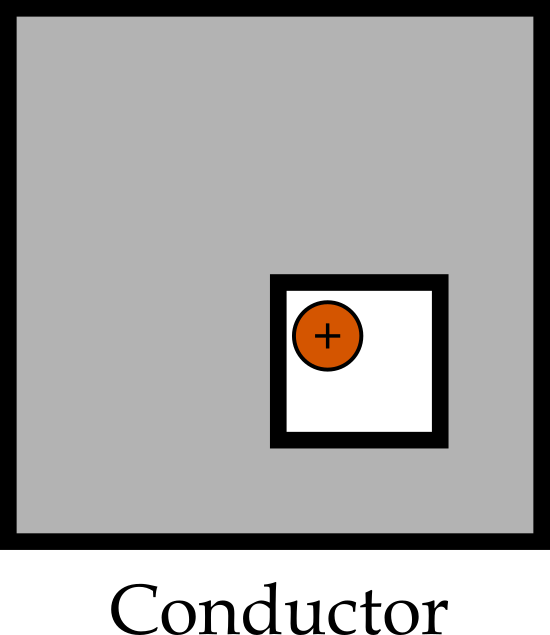
Suppose you place a positive charge in a cavity inside the conductor below. Sketch a charge diagram for the conductor.
Figure 25.11.1. A positive charge within a cavity in a conductor.
Activity 25.11.2 . Inside a Capacitor I.
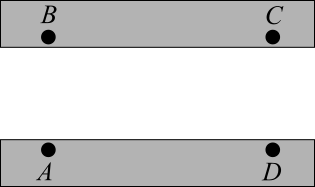
The capacitor shown below is made out of two parallel conducting plates. Initially,
\(V = 0\) at point A and
\(V = 9 \mathrm{~V}\) at point B.
Figure 25.11.2. A capacitor made of two conducting plates.
(a) Are the conducting plates in electrostatic equilibrium?
(b) Sketch a charge diagram for the capacitor.
(c) Sketch the electric field inside the capacitor.
(d) Determine the potential at each point.
(e) Describe all changes in the electric potential as you travel around the path
\(A \rightarrow B \rightarrow C \rightarrow D \rightarrow A\text{.}\)
Activity 25.11.3 . Inside a Capacitor II.
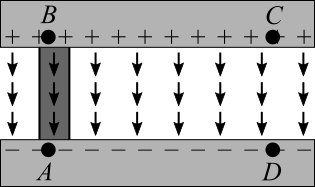
Suppose you connect the two plates of the capacitor with a third conductor between points A and B, as in the figure below.
Figure 25.11.3. A capacitor made of two conducting plates, with a third conductor.
(a) Are the conducting plates in electrostatic equilibrium?
(b) Describe what you expect to happen physically to the charges (you may want to draw multiple charge diagrams showing the situation over time).
(c) Give a mechanistic explanation for your expectation based on the electric field or the electric potential.
(d) As before, describe all changes in the electric potential as you travel around the path
\(A \rightarrow B \rightarrow C \rightarrow D \rightarrow A\text{.}\)