Learning Introductory Physics with Activities

Section 21.8 Representations of Electric Fields

Subsubsection Activities

Activity 21.8.1. Electric Field Generator.

Suppose you have a proton in your physics lab. You would like to cause the proton to float suspended in the middle of the lab, and all you have is a single electric field generator located on the floor. You can program this generator to make an electric field with any magnitude in any direction.

(a)

Determine the settings of your electric field generator (i.e., the magnitude and the direction) that will cause the proton to float.

(b)

What would you need to change if you had an electron instead of a proton?

Activity 21.8.2. Charged Ball.

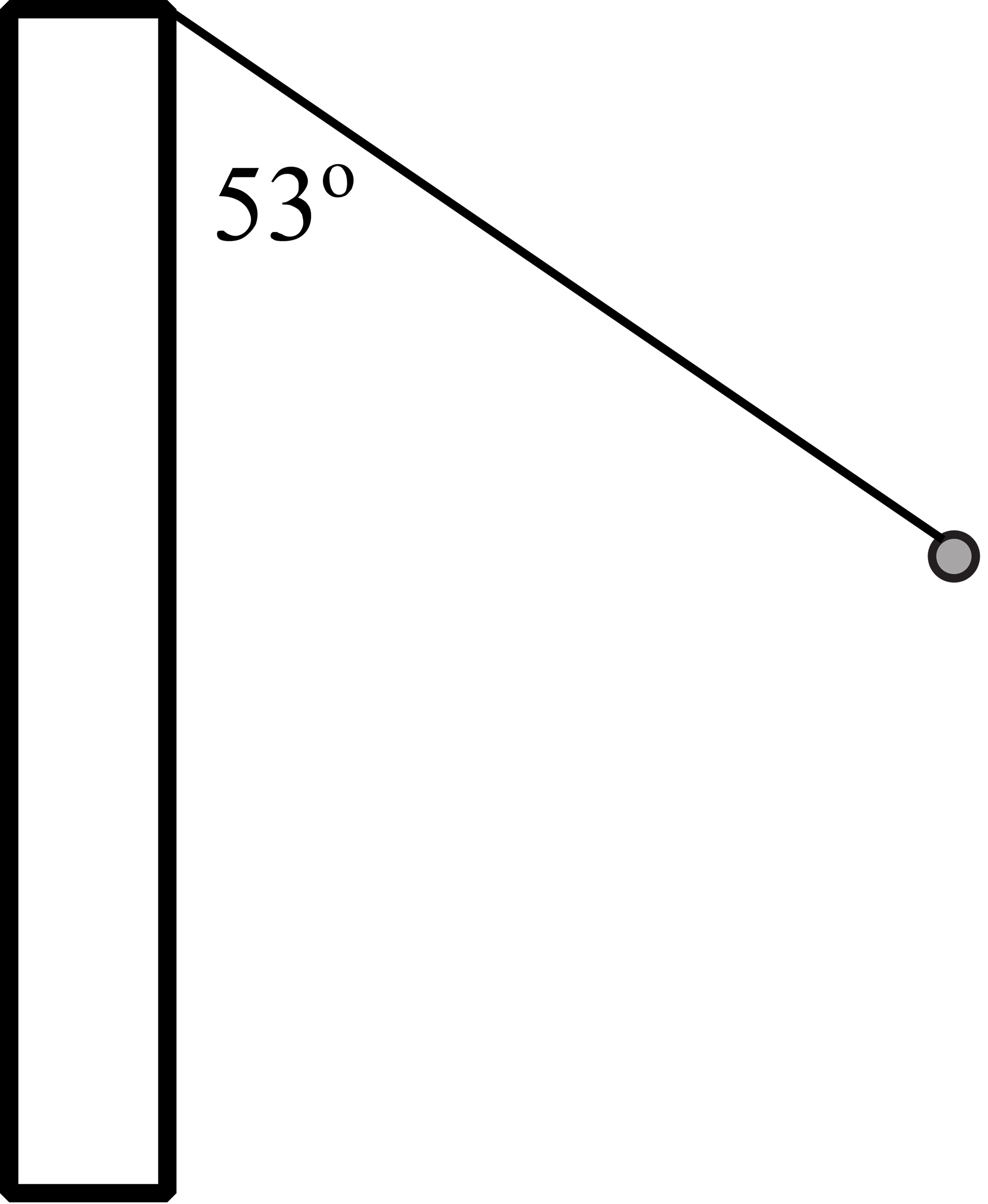
An electrically charged ball with \(m = 0.06 \mathrm{~kg}\) hangs at the end of a string oriented \(\theta = 53^o\) outward from a wall. The wall produces a uniform electric field with magnitude \(E = 105 \mathrm{~N/C}\) that points away from the wall (to the right).
A vertical wall on the left with a string connected to the top, its other end connected to a ball at an angle of 53 degrees.
Figure 21.8.1. A charged ball connected to a string.

(a)

Analyze and Represent: Draw a free-body diagram!

(b)

Calculate: Determine a symbolic expression for the electric charge on the ball.

(c)

Sensemake: What do you expect to happen to q in the special case that \(E = 0\text{?}\) What about \(\theta = 0\text{?}\)

Activity 21.8.3. Vector Maps.

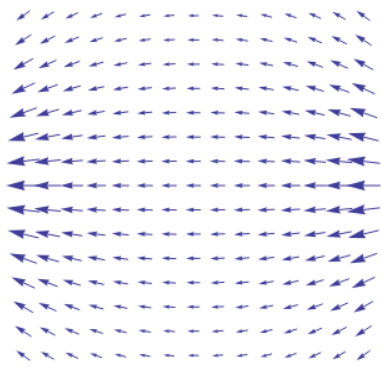
Shown below is an electric field vector map.
A map of arrows with a different arrow at every point on a grid.
Figure 21.8.2. A example electric field vector map with different values at different points on a grid.

(a)

Choose any point on the map and discuss the following: (1) How do you find the direction of the electric field at your chosen point? (2) How do you find the magnitude of the electric field at your chosen point?

(b)

Identify one or more locations where the electric field is the largest.

(c)

Identify one or more locations where the electric field is the smallest. Is \(E\) zero anywhere on this map?

(d)

Suppose a positive point charge is located at the middle of the map’s right edge. Describe what will happen to the charge over time. What do you think will happen to charges placed at other locations?