Skip to main content\(\newcommand{\N}{\mathbb N}
\newcommand{\Z}{\mathbb Z}
\newcommand{\Q}{\mathbb Q}
\newcommand{\R}{\mathbb R}
\newcommand{\lt}{<}
\newcommand{\gt}{>}
\newcommand{\amp}{&}
\definecolor{fillinmathshade}{gray}{0.9}
\newcommand{\fillinmath}[1]{\mathchoice{\colorbox{fillinmathshade}{$\displaystyle \phantom{\,#1\,}$}}{\colorbox{fillinmathshade}{$\textstyle \phantom{\,#1\,}$}}{\colorbox{fillinmathshade}{$\scriptstyle \phantom{\,#1\,}$}}{\colorbox{fillinmathshade}{$\scriptscriptstyle\phantom{\,#1\,}$}}}
\)
Section 27.5 Using Magnetic Fields
Activity 27.5.1. Warmup.
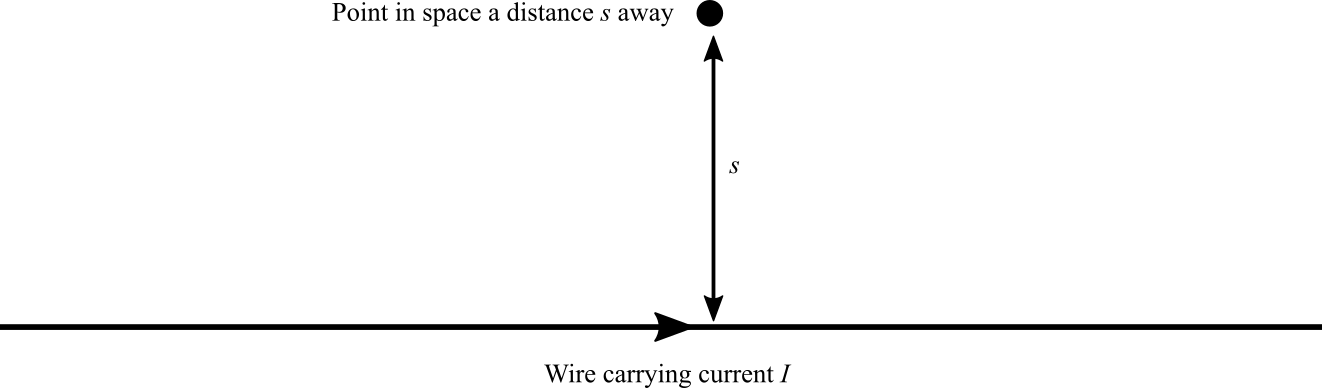
The two wires shown carry the same current
\(I\text{.}\) Indicate the direction of the magnetic field at each marked point.
Activity 27.5.2. The Current Loop.
A circular loop of wire carries a constant clockwise current
\(I\text{.}\)
(a)
What direction is the magnetic field at the center of the loop?
Hint.
Try adding up the magnetic fields from the current at a few different points around the loop.
(b)
What strategy do you think you could use to find the magnitude of the magnetic field?
Solution.
Chop: \(vdq = \frac{ds}{dt}dq = ds\frac{dq}{dt} = Ids\)
Multiply: \(d\vec{B} = \frac{\mu_0}{4\pi}\frac{dq v}{R^2}(-\hat{z}) = \frac{\mu_0}{4\pi}\frac{IRd\theta}{R^2}(-\hat{z})\)
Add: \(\vec{B} = \int d\vec{B} = \frac{\mu_0}{2}\frac{I}{R}(-\hat{z})\)
Definition 27.5.2. Magnetic Field Created by a Current Loop.
The magnitude of the magnetic field created by a circular loop of radius \(R\) carrying current \(I\) at its center is
\begin{equation*}
\vec{B} = \frac{\mu_0}{2}\frac{NI}{R}
\end{equation*}
Here \(N\) is the number of coils in the loop: \(N = 1\) for a single loop.
Figure 27.5.3. The magnetic field created by a current loop.
Activity 27.5.3. The Wire Segment.
A wire segment of length
\(L\) carries current
\(I\) to the right. What is the magnetic field above the center of the wire?
(a)
Sketch a diagram of the wire.
(b)
Chop the wire up into pieces with current
\(\vec{I}dx\text{.}\) Sketch at least one piece on your diagram.
(c)
Multiply using the Biot-Savart Law to find the magnetic field created by the small piece of the wire. Sketch this
\(\vec{dB}\) on your diagram.
(d)
Add the
\(\vec{dB}\) pieces using an integral to find the net magnetic field!
References References
[1]