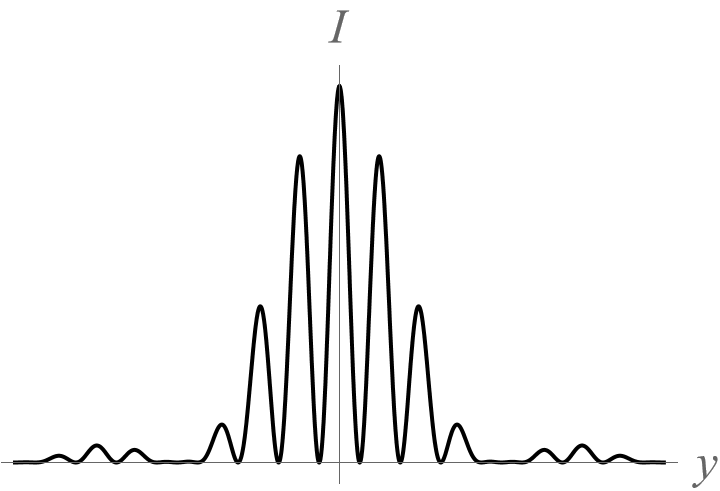
Activity 20.1.1. Intensity Pattern Points.
In each pattern above, mark at least three different points where it is easy to write a relationship between the wavelength of the light and the position or angle to the point on the screen
Answer.
In the first graph (for single-slit diffraction), it is relatively easy to locate the diffraction minima. The first diffraction minima, for example, is located at a point on the screen where \(a\sin\theta=\lambda\text{,}\) where \(a\) is the width of the slit.
In the second graph (for double-slit interference), it is relatively easy to locate either maxima or minima. The first principal maximum to either the left or the right is located at a point on the screen where \(d\sin\theta=\lambda\text{,}\) where \(d\) is the width of the slit.