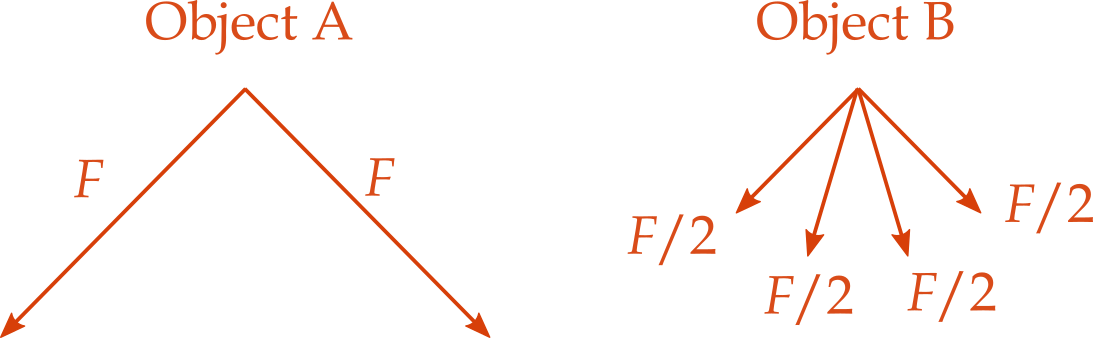
Three students are trying to move a box that is preventing them from going home after a long day of doing physics. All the students are equally strong: that is, they can all exert a force of the same magnitude if they push on something. Each student has a different idea about how best to push on the box to get it to move. Which student do you most agree with?
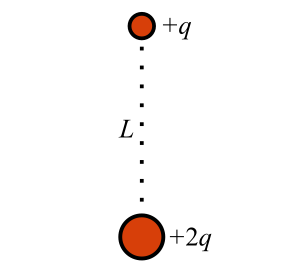
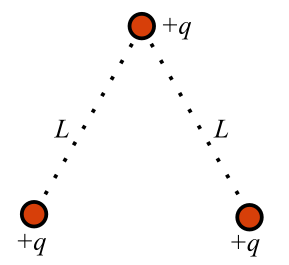
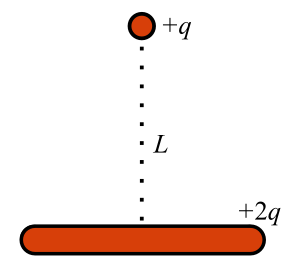
The large point charge is split into two smaller point charges and separated, as shown in the figure, so that each new charge is still a distance \(L\) away from the upper charge.
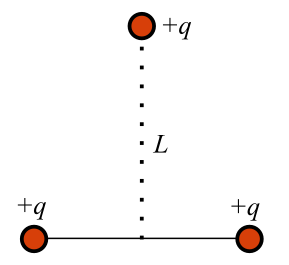
Suppose that when the large point charge is split into two smaller point charges, they are instead moved horizontally, so that each new charge lies along a horizontal line passing through the original point charge, as shown in the figure.
Explain why the magnitude of the net electric force on the upper charge is not the same as it is in any of the previous situations. Discuss possible methods you might use to calculate the electric force on \(+q\text{.}\) (You do not have to calculate this force.)