Skip to main content \(\newcommand{\N}{\mathbb N}
\newcommand{\Z}{\mathbb Z}
\newcommand{\Q}{\mathbb Q}
\newcommand{\R}{\mathbb R}
\newcommand{\lt}{<}
\newcommand{\gt}{>}
\newcommand{\amp}{&}
\definecolor{fillinmathshade}{gray}{0.9}
\newcommand{\fillinmath}[1]{\mathchoice{\colorbox{fillinmathshade}{$\displaystyle \phantom{\,#1\,}$}}{\colorbox{fillinmathshade}{$\textstyle \phantom{\,#1\,}$}}{\colorbox{fillinmathshade}{$\scriptstyle \phantom{\,#1\,}$}}{\colorbox{fillinmathshade}{$\scriptscriptstyle\phantom{\,#1\,}$}}}
\)
Section 5.5 Using Action-Reaction Pairs
Subsubsection Practice Activities
Activity 5.5.1 . The Book Stack.
A stack of two books is at rest on a table.
Figure 5.5.1. A stack of two books. Use
Force Analysis to identify all Action-Reaction (Newton’s 3rd Law) Pairs and identify any forces that are equal in magnitude.
A*R*C*S 5.5.2 . Uh-Oh Dr. Paws.
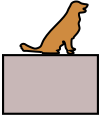
The instructor pushes a footstool (mass
\(m_1\) ) across the floor with a constant force so that the footstool speeds up. Dr. Paws (a dog with mass
\(m_2\) ) is sitting on the footstool. The coefficient of static friction between the dog and footstool is
\(\mu\) (assume no friction with the ground).
Figure 5.5.2. A simplified sketch of a dog on a footstool. Determine how much force the instructor can exert on the footstool before the dog begins sliding.
(a) 1. Analyze and Represent.
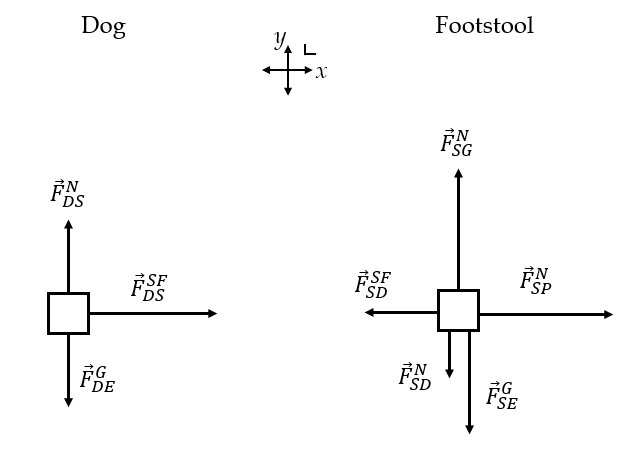
In the example that follows, describe why the assumptions are reasonable, identify all Action-Reaction (Newton’s 3rd Law) Pairs, and identify and fix the problems with the free-body diagrams.
Mass of the footstool:
\(m_1 = 10 \mathrm{~kg}\)
Mass of the dog:
\(m_2 = 30 \mathrm{~kg}\)
Coefficient of static friction:
\(\mu = 0.4\)
Instructor force:
\(F_i = ?\)
Near-earth:
\(g = 10 \mathrm{~m/s^2}\text{;}\) particle-model; neglect air-resistance; no friction with the ground.
Represent the situation physically.
Figure 5.5.3. Two free-body diagrams.
(b) 3. Sensemake.
You have three friends who each calculate a different equation for the maximum allowable force the instructor can apply:
\begin{equation*}
F_{SP}^N = \mu \frac{𝑚_1}{𝑚_1 + 𝑚_2}g
\end{equation*}
\begin{equation*}
F_{SP}^N = \mu\left( 𝑚_2 - 𝑚_1 \right)g
\end{equation*}
\begin{equation*}
F_{SP}^N = \mu \frac{𝑚_1 𝑚_2}{(𝑚_1 + 𝑚_2}g
\end{equation*}
Use a sensemaking strategy to give a reason why each expression is incorrect .
(c) 2. Calculate.
Represent physics principles that will help you solve for the tension and the acceleration.
Determine a symbolic equation for each unknown quantity in terms of known variables.
Plug numbers into your symbolic answer.
Activity 5.5.3 . The Block Race.
Block A is accelerated across a frictionless table by a hanging
\(10 \mathrm{~N}\) mass. An identical block B is accelerated by a constant
\(10 \mathrm{~N}\) tension in the string.
Figure 5.5.4. Two Blocks connected to strings.
(a) Before you begin, predict which block you think will have a larger acceleration.
(b) Use
Force Analysis to determine the acceleration of each block. Sketching free-body diagrams for each object is essential!
A*R*C*S 5.5.4 . The Pair of Blocks.
Blocks A and B are connected by an ideal string via a massless pulley. The coefficient of kinetic friction is
\(\mu\text{.}\)
Figure 5.5.5. Two Blocks connected by a string over a pulley. Use the
A*R*C*S Steps to determine the acceleration of each block.
This situation is a particularly good one for special-case analysis: what are some cases you might want to try?
A*R*C*S 5.5.5 . The Pair of Pulleys.
Blocks A and B are connected by an ideal string via two massless pulleys.
Figure 5.5.6. Two Blocks connected by a string to two pulleys. Use the
A*R*C*S Steps to determine the acceleration of each block.
Hint .
The magnitudes of the block’s accelerations are different. How can you relate them?