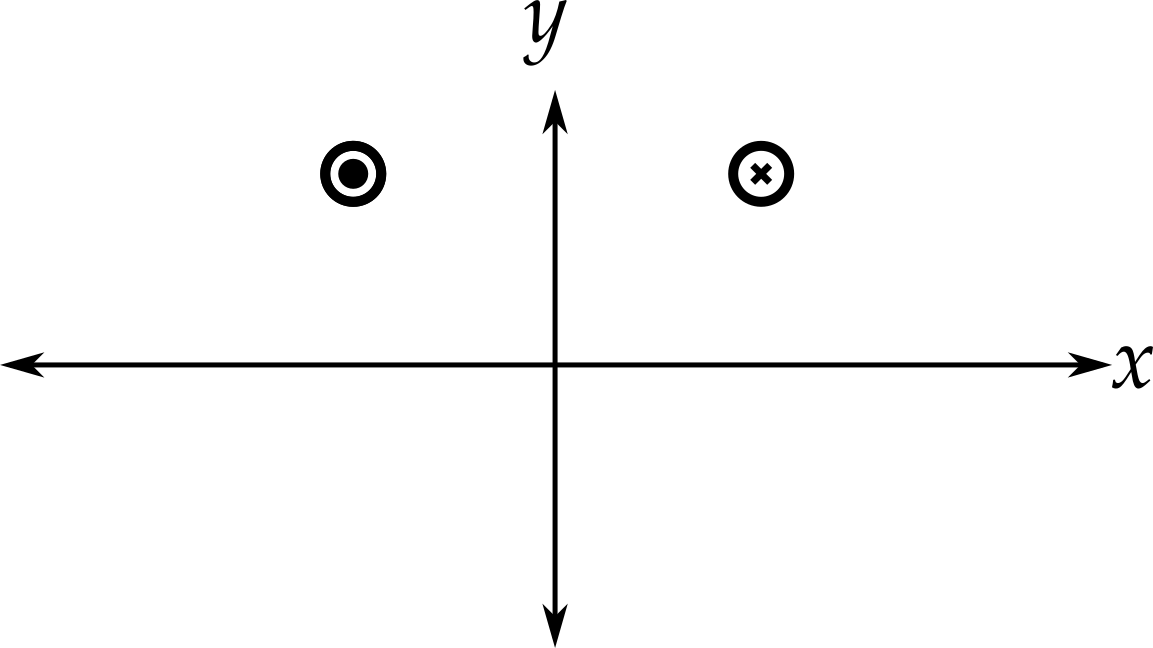
The two wires shown in the figure above carry identical currents \(I_1\text{,}\) one into the page and one out of the page. Each wire is positioned a distance \(d\) from the origin at an angle of \(45^o\) down from the positive \(y\)-axis.
You want to position a third wire, carrying current \(I_1\) out of the page, in such a way that the net magnetic field at the origin is equal to zero. Give a complete explanation that determines the location of this third wire.
A very long half-cylinder of radius \(R\) (see picture above) carries a total current \(I\) uniformly distributed across the circumference. Calculate the magnetic field along the central axis of the cylinder.
Consider the magnetic field created by an infinitely long solenoid with radius \(R\) and \(n\) coils per unit length carrying a steady clockwise current \(I\text{.}\) Starting from the assumption that the magnetic field everywhere in space must point in either the positive or negative \(z\)-direction (parallel to the axis of the solenoid), use Ampere’s Law to determine the magnitude and direction of this magnetic field.
Find two activities related to electric fields that are similar to the activities you completed this week for magnetic fields. Discuss the main similarities and differences between the two fields.